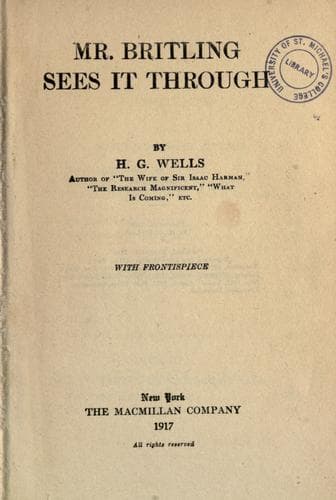
Mr. Britling Sees It ThroughWells, H. G. (Herbert George)
General
Mr. Britling Sees It Through
Wells, H. G. (Herbert George)
War stories; World War, 1914-1918 -- Fiction
"They'd get killed all the more if you had--let us say--Carson and
Lloyd George and Northcliffe and Lady Frensham, with, I suppose, Austin
Harrison and Horatio Bottomley thrown in--as a Strong Silent
Government.... I'd rather have Northcliffe as dictator than that.... We
can't suddenly go back on the past and alter our type. We didn't listen
to Matthew Arnold. We've never thoroughly turned out and cleaned up our
higher schools. We've resisted instruction. We've preferred to maintain
our national luxuries of a bench of bishops and party politics. And
compulsory Greek and the university sneer. And Lady Frensham. And all
that sort of thing. And here we are!... Well, damn it, we're in for it
now; we've got to plough through with it--with what we have--as what we
are."
The young staff officer nodded. He thought that was "about it."
"You've got no sons," said Mr. Britling.
"I'm not even married," said Raeburn, as though he thanked God.
The little well-informed lady remarked abruptly that she had two sons;
one was just home wounded from Suvla Bay. What her son told her made her
feel very grave. She said that the public was still quite in the dark
about the battle of Anafarta. It had been a hideous muddle, and we had
been badly beaten. The staff work had been awful. Nothing joined up,
nothing was on the spot and in time. The water supply, for example, had
gone wrong; the men had been mad with thirst. One regiment which she
named had not been supported by another; when at last the first came
back the two battalions fought in the trenches regardless of the enemy.
There had been no leading, no correlation, no plan. Some of the guns,
she declared, had been left behind in Egypt. Some of the train was
untraceable to this day. It was mislaid somewhere in the Levant. At the
beginning Sir Ian Hamilton had not even been present. He had failed to
get there in time. It had been the reckless throwing away of an army.
And so hopeful an army! Her son declared it meant the complete failure
of the Dardanelles project....
"And when one hears how near we came to victory!" she cried, and left it
at that.
Public-domain text, read in full here on John Shaqi.
Reviews
Reviews
No reviews yet
Be the first to share your thoughts on this work.
Elsewhere in the archive
Join the Discussion
Join the discussion
Sign in to leave a comment or review.
Sign InorCreate an account