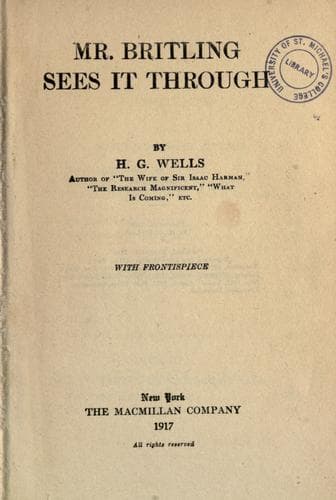
Mr. Britling Sees It ThroughWells, H. G. (Herbert George)
General
Mr. Britling Sees It Through
Wells, H. G. (Herbert George)
War stories; World War, 1914-1918 -- Fiction
"When it began I did not believe that this war could be like other
wars," he said. "I did not dream it. I thought that we had grown wiser
at last. It seemed to me like the dawn of a great clearing up. I thought
the common sense of mankind would break out like a flame, an indignant
flame, and consume all this obsolete foolery of empires and banners and
militarism directly it made its attack upon human happiness. A score of
things that I see now were preposterous, I thought must
happen--naturally. I thought America would declare herself against the
Belgian outrage; that she would not tolerate the smashing of the great
sister republic--if only for the memory of Lafayette. Well--I gather
America is chiefly concerned about our making cotton contraband. I
thought the Balkan States were capable of a reasonable give and take; of
a common care for their common freedom. I see now three German royalties
trading in peasants, and no men in their lands to gainsay them. I saw
this war, as so many Frenchmen have seen it, as something that might
legitimately command a splendid enthusiasm of indignation.... It was all
a dream, the dream of a prosperous comfortable man who had never come to
the cutting edge of life. Everywhere cunning, everywhere small feuds and
hatreds, distrusts, dishonesties, timidities, feebleness of purpose,
dwarfish imaginations, swarm over the great and simple issues.... It is
a war now like any other of the mobbing, many-aimed cataclysms that have
shattered empires and devastated the world; it is a war without point, a
war that has lost its soul, it has become mere incoherent fighting and
destruction, a demonstration in vast and tragic forms of the stupidity
and ineffectiveness of our species...."
He stopped, and there was a little interval of silence.
Captain Carmine tossed the fag end of his cigar very neatly into a tub
of hydrangeas. "Three thousand years ago in China," he said, "there were
men as sad as we are, for the same cause."
"Three thousand years ahead perhaps," said Mr. Britling, "there will
still be men with the same sadness.... And yet--and yet.... No. Just now
I have no elasticity. It is not in my nature to despair, but things are
pressing me down. I don't recover as I used to recover. I tell myself
still that though the way is long and hard the spirit of hope, the
spirit of creation, the generosities and gallantries in the heart of
man, must end in victory. But I say that over as one repeats a worn-out
prayer. The light is out of the sky for me. Sometimes I doubt if it will
ever come back. Let younger men take heart and go on with the world. If
I could die for the right thing now--instead of just having to live on
in this world of ineffective struggle--I would be glad to die now,
Carmine...."
Section 17
In these days also Mr. Direck was very unhappy.
Public-domain text, read in full here on John Shaqi.
Reviews
Reviews
No reviews yet
Be the first to share your thoughts on this work.
Elsewhere in the archive
Join the Discussion
Join the discussion
Sign in to leave a comment or review.
Sign InorCreate an account