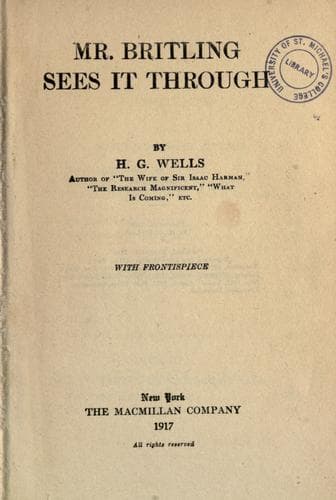
Mr. Britling Sees It ThroughWells, H. G. (Herbert George)
General
Mr. Britling Sees It Through
Wells, H. G. (Herbert George)
War stories; World War, 1914-1918 -- Fiction
She herself was in a tangle. She had grown to be very fond of Mr.
Direck, and to have a profound trust and confidence in him, and her
fondness seemed able to find no expression at all except a constant
girding at his and America's avoidance of war. She had fallen in love
with him when he was wearing fancy dress; she was a young woman with a
stronger taste for body and colour than she supposed; what indeed she
resented about him, though she did not know it, was that he seemed never
disposed to carry the spirit of fancy dress into everyday life. To begin
with he had touched both her imagination and senses, and she wanted him
to go on doing that. Instead of which he seemed lapsing more and more
into reiterated assurances of devotion and the flat competent discharge
of humanitarian duties. Always nowadays he was trying to persuade her
that what he was doing was the right and honourable thing for him to do;
what he did not realise, what indeed she did not realise, was the
exasperation his rightness and reasonableness produced in her. When he
saw he exasperated her he sought very earnestly to be righter and
reasonabler and more plainly and demonstrably right and reasonable than
ever.
Withal, as she felt and perceived, he was such a good thing, such a very
good thing; so kind, so trustworthy, with a sort of slow strength, with
a careful honesty, a big good childishness, a passion for fairness. And
so helpless in her hands. She could lash him and distress him. Yet she
could not shake his slowly formed convictions.
When Cissie had dreamt of the lover that fate had in store for her in
her old romantic days, he was to be _perfect_ always, he and she were
always to be absolutely in the right (and, if the story needed it, the
world in the wrong). She had never expected to find herself tied by her
affections to a man with whom she disagreed, and who went contrary to
her standards, very much as if she was lashed on the back of a very nice
elephant that would wince to but not obey the goad....
So she nagged him and taunted him, and would hear no word of his case.
And he wanted dreadfully to discuss his case. He felt that the point of
conscience about the munitions was particularly fine and difficult. He
wished she would listen and enter into it more. But she thought with
that more rapid English flash which is not so much thinking as feeling.
He loved that flash in her in spite of his persuasion of its injustice.
Her thought that he ought to go to the war made him feel like a
renegade; but her claim that he was somehow still English held him in
spite of his reason. In the midst of such perplexities he was glad to
find one neutral task wherein he could find himself whole-heartedly with
and for Cissie.
He hunted up the evidence of Teddy's fate with a devoted pertinacity.
Public-domain text, read in full here on John Shaqi.
Reviews
Reviews
No reviews yet
Be the first to share your thoughts on this work.
Elsewhere in the archive
Join the Discussion
Join the discussion
Sign in to leave a comment or review.
Sign InorCreate an account