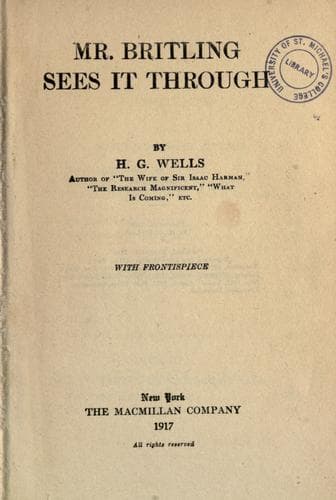
Mr. Britling Sees It ThroughWells, H. G. (Herbert George)
General
Mr. Britling Sees It Through
Wells, H. G. (Herbert George)
War stories; World War, 1914-1918 -- Fiction
Was it conceivable that this mad monster of mankind would ever be caught
and held in the thin-spun webs of thought?
Was it, after all, anything but pretension and folly for a man to work
out plans for the better government of the world?--was it any better
than the ambitious scheming of some fly upon the wheel of the romantic
gods?
Man has come, floundering and wounding and suffering, out of the
breeding darknesses of Time, that will presently crush and consume him
again. Why not flounder with the rest, why not eat, drink, fight,
scream, weep and pray, forget Hugh, stop brooding upon Hugh, banish all
these priggish dreams of "The Better Government of the World," and turn
to the brighter aspects, the funny and adventurous aspects of the war,
the Chestertonian jolliness, _Punch_ side of things? Think you because
your sons are dead that there will be no more cakes and ale? Let mankind
blunder out of the mud and blood as mankind has blundered in....
Let us at any rate keep our precious Sense of Humour....
He pulled his manuscript towards him. For a time he sat decorating the
lettering of his title, "The Better Government of the World," with
little grinning gnomes' heads and waggish tails....
Section 3
On the top of Mr. Britling's desk, beside the clock, lay a letter,
written in clumsy English and with its envelope resealed by a label
which testified that it had been "OPENED BY CENSOR."
The friendly go-between in Norway had written to tell Mr. Britling that
Herr Heinrich also was dead; he had died a wounded prisoner in Russia
some months ago. He had been wounded and captured, after undergoing
great hardships, during the great Russian attack upon the passes of the
Carpathians in the early spring, and his wound had mortified. He had
recovered partially for a time, and then he had been beaten and injured
again in some struggle between German and Croatian prisoners, and he had
sickened and died. Before he died he had written to his parents, and
once again he had asked that the fiddle he had left in Mr. Britling's
care should if possible be returned to them. It was manifest that both
for him and them now it had become a symbol with many associations.
The substance of this letter invaded the orange circle of the lamp; it
would have to be answered, and the potentialities of the answer were
running through Mr. Britling's brain to the exclusion of any impersonal
composition. He thought of the old parents away there in Pomerania--he
believed but he was not quite sure, that Heinrich had been an only
son--and of the pleasant spectacled figure that had now become a broken
and decaying thing in a prisoner's shallow grave....
Another son had gone--all the world was losing its sons....
Public-domain text, read in full here on John Shaqi.
Reviews
Reviews
No reviews yet
Be the first to share your thoughts on this work.
Elsewhere in the archive
Join the Discussion
Join the discussion
Sign in to leave a comment or review.
Sign InorCreate an account