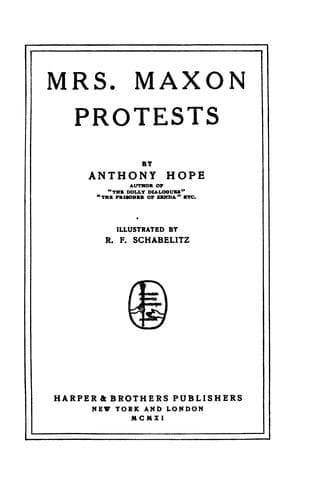
Divorce -- Fiction; Man-woman relationships -- Fiction; Marriage -- Fiction
stuck--up against that impalpable, impenetrable barrier.
"I've been talking--out on the balcony--with that funny little man they
call 'Dolly,'" she remarked. "He told me that, if you had nobody
dependent on you, and had a hundred and fifty pounds a year, you were in
a position to tell the truth."
"Is it exactly a question of what money you've got, Miss Winnie?" asked
the General.
She let the question pass. "Anyhow, that happens to be exactly my
income. Rather funny!" She looked across the small table at Mrs.
Lenoir--and was not surprised to find that Mrs. Lenoir was looking at
her already.
"I suppose he meant that if you weren't absolutely obliged to get or
keep some job----" the Major began.
"That's what he meant; and there's a lot in it, isn't there, Major
Merriam?"
"Well, it's not what we're taught at school, but perhaps there is."
"More luxuries for the rich," smiled Mrs. Lenoir.
"The Radicals can make a new grievance out of it at the next election,"
said the General.
Of course, the two men did not know what underlay Winnie's talk. Equally
of course, Mrs. Lenoir did; she saw it in a minute, and her reading
hardly needed the confirmation of Bertie's glum demeanour. Winnie was in
rebellion--probably in irreconcilable rebellion. Mrs. Lenoir glanced
across at her with a satirically protesting smile. Winnie smiled back,
but her eyes were resolute--rather merrily resolute, as though she liked
this new taste of her favourite cup of defiance.
"There are times and seasons," said Mrs. Lenoir. "Isn't there even a
thing called the economy of truth? I don't think I know the exact
doctrine."
"You wouldn't tell a child everything--or a fool either," observed the
General.
"Would you choose the wrong time to tell the truth to anybody?" Mrs.
Lenoir asked.
"Are you entitled to settle what's the right time--all by yourself?"
Winnie retorted gaily. Her spirits had begun to rise. This was almost
like a discussion at Shaylor's Patch. There was a deeper reason. With
her determination had come a sense of recovered honesty, and, more, of
liberty regained. Whatever the Merriams might think, she would be
herself again--herself and no longer Miss Winnie Wilson, a young person
whom, in the last week or so, she had begun to hate cordially.
Winnie did not go to the casino that evening; she left the General and
his son to walk there together. She followed Mrs. Lenoir into the
drawing-room, and sat down by her.
"So you've made up your mind, Winnie?" Mrs. Lenoir did not seem angry or
hurt. She merely recognized Winnie's resolution.
"Yes. I can't go on with it. And it's a good moment. The newspapers come
to-morrow, and, if what Hobart Gaynor told me was right, there'll be
something about me in them."
Public-domain text, read in full here on John Shaqi.
Reviews
Reviews
No reviews yet
Be the first to share your thoughts on this work.
Elsewhere in the archive
Join the Discussion
Join the discussion
Sign in to leave a comment or review.
Sign InorCreate an account