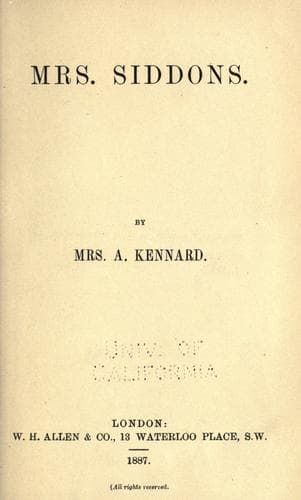
Actresses -- Great Britain -- Biography; Siddons, Sarah, 1755-1831
It sends a pang through our heart as we hear Mrs. Siddons say in later
life, with a sigh, to Rogers the poet: “After I became famous, none of my
sisters loved me so well.” What a price to pay for fame! “Conversation”
Sharp was frequently consulted by her upon private affairs. She wept
to him over the ingratitude her sisters showed her. Money was lent and
never repaid; the prestige of her name was borrowed to obtain theatrical
engagements, but she never was thanked; every obligation seemed only to
cause a feeling of bitterness. Perhaps the fault lay a little on her
side as well as on theirs. Tact and graciousness were not her strong
points. She was absent-minded, all her attention being concentrated on
the study and comprehension of her profession, which gave her a proud,
self-contained manner, alienating unconsciously those who surrounded her
and were dependent on her. Her children adored her, but her brothers
and sisters stood, to a certain extent, in awe of her. All of them,
stimulated by the examples of the two eldest, went on the stage, but
none possessed her genius, or John Kemble’s talent and industry. The
affectionate comradeship in art that existed between Mrs. Siddons and
John Kemble is one of the pleasantest features in both their lives.
He was educated, as we have seen, principally at the Roman Catholic
College at Douay, where he became remarkable for his elocution, every
now and then astonishing his masters and schoolfellows by delivering
speeches in scholastic Latin, and learning with the greatest facility
books of Homer and odes of Horace. We are told that his noble cast of
countenance, his deep melodious voice, and the dignity of his delivery,
impressed his comrades considerably; especially in the scene between
Brutus and Cassius, which he got up for their benefit. It is a curious
proof of his want of facility that, although he was extremely fond of
the study of language, grammar being all his life his favourite _light
reading_, he never was able to master any language but his own. He read
Italian, Spanish, and French, but spoke none of them, in spite of his
education in France and his long residence later at Lausanne. He had no
ear, and it never could have been an easy task to him to learn the rhythm
of Shakespeare. We know the story of old Shaw, conductor of the Covent
Garden orchestra, who vainly endeavoured to teach him the song in the
piece of _Richard Cœur de Lion_, “O Richard—O mon roi!” “Mr. Kemble, Mr.
Kemble, you are murdering the time, Sir!” cried the exasperated musician;
on which Kemble made one of the few jokes ever perpetrated by him: “Very
well, Sir, and you are for ever beating it.”
Public-domain text, read in full here on John Shaqi.
Reviews
Reviews
No reviews yet
Be the first to share your thoughts on this work.
Elsewhere in the archive
Join the Discussion
Join the discussion
Sign in to leave a comment or review.
Sign InorCreate an account