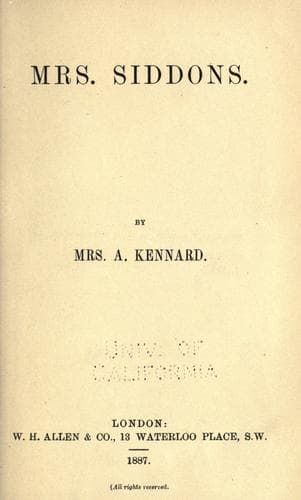
Actresses -- Great Britain -- Biography; Siddons, Sarah, 1755-1831
When the “little man” arrived in London, Kemble and Mrs. Siddons
announced their intention of honouring with their presence the new
actor’s performance of Othello. A relative of Kean, who was very
anxious about the result of the Kemble decision, placed herself in a
box opposite, to observe the effect the performance produced on them.
The Queen of Tragedy sat erect and looked cold; Mr. Kemble gave a grave
attention. But as the young actor warmed to his part, Mrs. Siddons
showed a pleased surprise, and at last leaned forward, her fine head on
her arm, quite engrossed in the scene, while Kemble expressed continual
approbation, turning to his sister as each point told. At the triumphant
close of the performance, Kean’s friend approached the Kembles’ box. Mrs.
Siddons would not allow that this extraordinary genius was the lad that
had acted with her before. “Perhaps,” she said, “he had assumed the name
of Kean.” “Then the present one has every right to drop it,” said Kemble;
“he is not Kean, but the real Othello.” Yet Kemble must have known that
night that a greater than he had arisen. It must have been a noteworthy
scene, those two remarkable figures of a by-gone age, sitting in judgment
on “the little gentleman who,” as Kemble said, “was always so terribly
in earnest,” while he fretted and fumed on that stage, where he was
destined to initiate a new ideal of dramatic art.
Macready gives an interesting account of his first meeting the great
actress whom every young aspirant looked up to with such awe. It was at
Newcastle; the _Gamester_ and _Douglas_ were the plays selected, and the
young actor received the appalling information that he was to act with
her. With doubt, anxiety, and trepidation he set about his work, the
thought of standing by the side of the great mistress of her Art hanging
over him _in terrorem_. At last she arrived, and he received orders to go
to the Queen’s Head Hotel to rehearse. The impression, he says, the first
sight of her made on him recalled the page’s description of the effect of
Jane de Montfort’s appearance on him in Joanna Baillie’s tragedy. It was
So queenly, so commanding, and so noble.
In her grand, but good-natured manner, having seen his nervousness, she
said, “I hope, Mr. Macready, you have brought some hartshorn and water
with you, as I am told you are terribly frightened at me,” and she made
some remarks about his being a very young husband. Her daughter Cecilia
went smiling out of the room, and left them to the business of the
morning.
Her instructions were vividly impressed on the young actor’s memory,
and he took his leave with fear and trembling. The audience were, as
usual, encouraging, and the first scene passed with applause; but in the
next—his first with Mrs. Beverley—his fear overcame him to that degree,
that for a minute his presence of mind forsook him; his memory seemed to
have gone, and he stood bewildered. She kindly whispered the word to him,
and the scene proceeded.
Public-domain text, read in full here on John Shaqi.
Reviews
Reviews
No reviews yet
Be the first to share your thoughts on this work.
Elsewhere in the archive
Join the Discussion
Join the discussion
Sign in to leave a comment or review.
Sign InorCreate an account