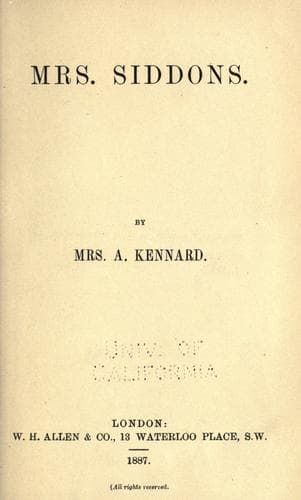
Actresses -- Great Britain -- Biography; Siddons, Sarah, 1755-1831
“Mrs. Siddons came in the evening; had a good deal of conversation with
her, and was, for the first time in my life, interested by her off the
stage. She talked of the loss of friends, and mentioned herself as having
lost twenty-six friends in the course of the last six years. It is
something to _have had_ so many. Among other reasons for her regret at
leaving the stage was, that she always found in it a vent for her private
sorrows, which enabled her to bear them better; and often she has got
credit for the truth and feeling of her acting when she was doing nothing
more than relieving her own heart of its grief.”
She took her professional farewell of the stage on the 29th of June 1812.
As early as three o’clock in the afternoon people began to assemble
about the pit and gallery doors, and at half-past four the mob was so
great, that those who had come early, in the hope of getting a good
place, were carried away by the rush of the increasing crowd under the
arches. So great was the concourse of people, that not more than twenty
of the weaker sex obtained places in the pit, and the house was crammed
in every part. The play was _Lady Macbeth_. When the great actress made
her appearance, she was received with thunders of applause; for a moment
emotion overcame her, but, collecting herself, she went through her
part as magnificently as in the early days. Often have old play-goers
described the scene on that night. The grand pale face; the pathetic
voice on the stage, speaking its last to those whom it had delighted and
thrilled for so many years. While among the audience, the heart-felt
sorrow, the deep silence, only broken by smothered sobs; then the
irrepressible burst of feeling when the scene, in which she appears for
the last time in _Lady Macbeth_ was over, for the audience could bear it
no longer. The applause continued from the time of her going off till
she again appeared, to speak her address. When silence was restored, she
began the following farewell, written by her nephew Horace Twiss:—
Who has not felt how growing use endears
The fond remembrance of our former years?
Who has not sigh’d, when doom’d to leave at last
The hopes of youth, the habits of the past,
Ten thousand ties and interests, that impart
A second nature to the human heart,
And wreathing round it close, like tendrils, climb,
Blooming in age, and sanctified by time!
Yes! at this moment crowd upon my mind
Scenes of bright days for ever left behind,
Bewildering visions of enraptured youth,
When hope and fancy wore the hues of truth,
And long forgotten years, that almost seem
The faded traces of a morning dream!
Sweet are those mournful thoughts: for they renew
The pleasing sense of all I owe to you,
For each inspiring smile, and soothing tear—
For those full honours of my long career,
That cheer’d my earliest hope and chased my latest fear.
Public-domain text, read in full here on John Shaqi.
Reviews
Reviews
No reviews yet
Be the first to share your thoughts on this work.
Elsewhere in the archive
Join the Discussion
Join the discussion
Sign in to leave a comment or review.
Sign InorCreate an account