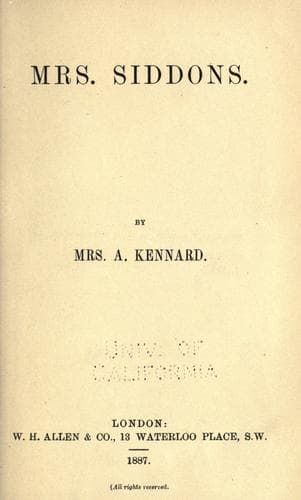
Actresses -- Great Britain -- Biography; Siddons, Sarah, 1755-1831
Unfortunately, she ventured out driving soon afterwards, the day was
cold, and a chill seemed to have developed the erysipelas internally. On
the 31st May she was seized with sickness and ague, and in the course of
the evening both her legs were attacked with erysipelas inflammation.
This increased during the night, and was accompanied by much fever. In
the course of the following day there was a consultation of doctors. They
pronounced the case hopeless, mortification supervened, and about nine on
the morning of the 8th June she expired, after a week of acute suffering.
On the 15th June she was buried in the New Ground of Paddington Church,
followed to the grave by her brother Charles Kemble, two sons of Henry
Siddons, and many others. Alas! of her own immediate family few were
left, and her eldest son was in India. In the procession were eleven
mourning coaches, with the performers of the Theatre Royal Drury Lane
and Covent Garden. When the burial service had been read, a young woman,
Campbell tells us, knelt down beside the coffin with demonstrations of
the wildest grief. She came veiled, and her name was never discovered.
Why go into the items of the will Mrs. Siddons left, and the articles
she assigned to her heirs? To us she has bequeathed the memory of one of
the greatest dramatic artists that ever graced our stage, and of one of
the noblest of the long list of noble women enrolled in the annals of
our country. Time goes on whirling away all memories in its relentless
rush. A new generation is ever ready to depreciate the enthusiasms of
their grandfathers, and ours is incredulous when told of the powers of a
Garrick or a Siddons.
It was with a feeling of pain that, while standing the other day by the
great actress’s grave where it lies lonely and untended in Paddington
churchyard, we heard that our cousins across the Atlantic set more
store on the memory of Sarah Siddons than we do. Miss Mary Anderson,
the custodian told us, whenever she is in London, comes up on Sunday
afternoons, with parties of her countrymen, to lay fresh flowers on the
grave, and has undertaken, at her own expense, to execute all necessary
repairs to the railings and tombstone. Let us, before it is too late,
anticipate this high-minded and generous offer.
FOOTNOTES
[1] It was the same Lady Lucan who was said once to have asked the
actress: “Pray, Madam, when you are to prepare yourself in a character,
what is your _primary object_ of attention, the _superstructure_, as it
may be called, or the ‘foundation’ of the part?”
[2] Mrs. Piozzi, who, after Mr. Thrale’s death, had married again, much
to the disgust of the Johnsonian band.
[3] On the first night of the O. P. riots, we are told the actress wore
a costume fashioned after the bridal suit of the unfortunate Queen of
Scots, and was a perfect blaze with the jewels in the stomacher of the
dress, as well as upon her hair and around her neck.
London: Printed by W. H. Allen & Co., 13 Waterloo Place. S.W.
Public-domain text, read in full here on John Shaqi.
Reviews
Reviews
No reviews yet
Be the first to share your thoughts on this work.
Elsewhere in the archive
Join the Discussion
Join the discussion
Sign in to leave a comment or review.
Sign InorCreate an account