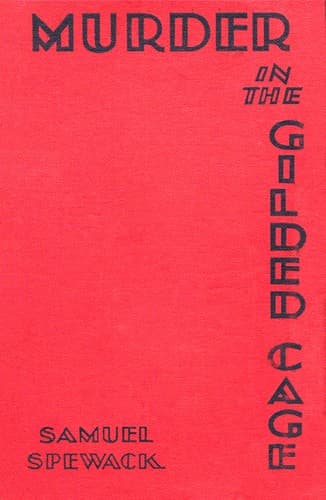
Americans -- Cuba -- Fiction; Detective and mystery stories; Havana (Cuba) -- Fiction; Murder -- Investigation -- Fiction
“But what’s happened?” demanded Breese. He seemed utterly bewildered.
“Perhaps you’ve already guessed,” countered the Russian strangely. “A
man has been murdered.”
“Never mind that!” Breese’s contempt for the figure before us chilled
me. “What’s happened with the ship? We’re moving.”
The Russian did not reply. The Countess was now sobbing as her former
husband led her from the room.
“You will be good enough to return immediately,” Perutkin called after
his protégé, who nodded. Then to the rest of us: “None of you will
leave this room.”
“Are we still in danger or not? That’s what I want to know!” Breese
cried, straining to look out of the window.
“One of us is out of danger,” the Russian said slowly, pointing to the
figure.
The Captain emerged from the corridor. He stopped short at the sight of
the body of his operator.
“How did this happen?” he demanded sharply. The Russian shrugged his
shoulders. The Captain’s thin lips set in one hard line. “You’re
responsible for this,” he said sternly.
“But it was not in my plan!” protested the Russian. “How could I know
such a disaster was possible?”
“What plan?” demanded Breese, listening open-mouthed, as we all did, to
the puzzling dialogue.
“You must know, Mr. Breese!” replied the Russian. “Surely you must have
guessed by now.”
“You’re talking in riddles,” snapped Breese. “What is it?”
The Captain addressed his employer. “Sir, you have every right to
discharge me,” he began. “At no time during this trip were we in any
danger. This man--” pointing to Perutkin--“asked me to convince you
that the ship was going down. He said I would help trap the murderer of
Mrs. Breese.”
“Certainly,” added the Russian. “It was a feasible plan. I argued that
the murderer of Mrs. Breese must be on this yacht. I argued that if
we could convince him that he faced death, he might be trapped into
a confession. He would feel he had nothing to lose. Unfortunately--”
the Russian gestured helplessly and it was not necessary for him to
conclude.
“You mean--you deliberately--staged this--this hoax!” Breese sputtered.
“Yes,” replied the Captain, “every bit of it. We did damage the
wireless set, but there was nothing else wrong. And it cost one poor
fellow his life.”
“Because,” explained the Russian, “the murderer was clever enough, Mr.
Breese, to guess our plan. I am amazed that a man like you was fooled.”
Once more his sharp little eyes stared at Breese. Then he continued
smoothly: “It was all in very bad taste, I’ll grant you. I could not
resist the temptation of the storm. It seemed a sign from the heavens.”
“We’re wasting time,” intervened Smith. “I want to ask you, Captain,
what you know of this poor chap?”
“His name is Louis Trenholm,” replied the Captain methodically.
“I think he was thirty-one. If I remember rightly I signed him on
myself--he came from Olean, New York. I don’t remember that he had any
living relatives.”
Smith noted these sparse details in his note-book.
Public-domain text, read in full here on John Shaqi.
Reviews
Reviews
No reviews yet
Be the first to share your thoughts on this work.
Elsewhere in the archive
Join the Discussion
Join the discussion
Sign in to leave a comment or review.
Sign InorCreate an account