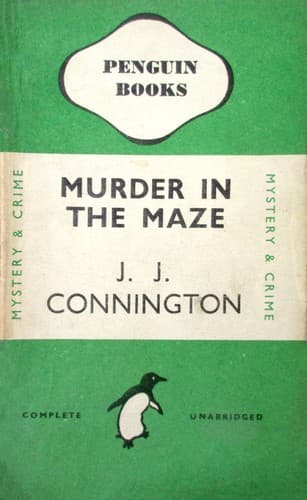
Country homes -- England -- Fiction; Detective and mystery stories; Murder -- Investigation -- Fiction
“I was near enough for all practical purposes, as you’ll see, Squire.
Now we come to what I thought it reasonable to infer from the facts.
First of all, an air-gun can be fired by either a man or a woman, so
the weapon didn’t even suggest the sex of the criminal. The poison was
obviously going to be a good clue; for it made the crime abnormal, so
to speak; and the more uncommon the method is in a murder, the more
you limit the possibilities in the identity of the murderer. Next, it
was clear enough that Roger had been shot while he was sitting in his
chair with his back to the murderer. In that position, only his
shoulders and neck would be exposed as targets and it was there that
he was hit. Neville, on the other hand, had been shot from the front
or slightly to the side. That suggested the possibility that Roger
might have been killed in mistake for Neville, whereas Neville could
not have been mistaken for Roger, since the murderer, shooting from
the front or side, could see his face as he fired.”
“Did you lay much stress on that in your mind?” Stenness asked.
“Not much at the time. It suggested that Roger might have been killed
first of all, by mistake, and that Neville was the man the murderer
was really after. But alone, it amounted to very little. Then comes
the fact that nothing seemed to have been removed from either body,
except the notes torn out of Neville’s hand. Of course, I’d been
following the Hackleton case; and it was clear enough that Neville
Shandon might have been put out of the way to keep him from examining
Hackleton. That’s been done before—remember how Maître Labori was shot
in the back as he was going into Court to examine General Mercier
during the Dreyfus case. I merely docketed that in my memory and kept
an open mind on the point. I hadn’t enough data to make it worth while
doing more.
“The next point was the discovery of the loopholes. That established
premeditation—the crime had been thought out and prepared for
beforehand. And that meant, further, that the murderer was someone who
knew that one or other of the Shandons was likely to be in the Maze
that afternoon or at least at some time thereabouts. That looked like
a local criminal at first sight. But one has to be judicial; and it
was clear enough that a premeditated crime might have been preceded by
a good deal of quiet spying; and thus an outsider might have got to
know the Shandons’ habits. One couldn’t lay much stress on that.”
“So at that point you didn’t know whether the Hackleton case came in
or not?” Stenness asked.
Public-domain text, read in full here on John Shaqi.
Reviews
Reviews
No reviews yet
Be the first to share your thoughts on this work.
Elsewhere in the archive
Join the Discussion
Join the discussion
Sign in to leave a comment or review.
Sign InorCreate an account