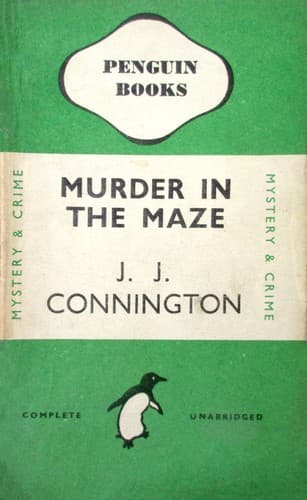
Country homes -- England -- Fiction; Detective and mystery stories; Murder -- Investigation -- Fiction
“If you look into criminology, you’ll find that the murderer for money
reasons is a fairly definite type. He’s usually clever enough to
devise a fresh method of murder, or of disposing of the body. Apart
from that, he’s not a very brainy type. And he has a terrible knack of
repeating the same method in successive crimes. Suppose you have to
cross a boiling torrent by stepping from stone to stone. You get
across the first time in safety. If you have to cross again, you’ll
choose the same stones as before. You’ve proved them to be safe. Any
other stones may be insecure and may bring you down. Now that’s the
state of mind of the mass-murderer when he goes in for his work. He
carries out his first crime by a novel method. He isn’t detected. So
when he tries his hand again he follows his first procedure slavishly
in all its mean details. These are the safe stepping-stones for him.
Look at the case of Smith, how he repeated all the minutiæ of his
bath-business time after time. Deeming used to put down a fresh cement
floor in a room to cover the bodies of his victims. He did that more
than once. He’d found it safe the first time, you see. If you read up
Burke and Hare’s doings, you’ll find them a steady repetition of the
same method applied without variation. It’s the mark of the
mass-murderer.
“So naturally, I expected the poisoned darts and the air-gun to come
into play again, if Ernest carried his work to a further stage. And I
made up my mind that I’d choose his next victim for him. He made two
deadly slips in that interview he had with us, Wendover. Perhaps you
noticed them?”
Wendover shook his head.
“You told me after our talk with him that I ought to know who the
murderer was; but I didn’t guess it. What slips did he make?”
“The first slip was when he volunteered that he had a bicycle and had
used it to get down to the Maze. Once I had information that he owned
a bicycle, his alibi with the sore toe disappeared instanter from my
mind. His second slip was a worse one. He said to us that he hadn’t
been down to the Maze since the murders. And then he let out that he
knew the position of the loophole through which Roger Shandon was
shot. Speaking of his mythical assailant he said: ‘He was at the same
loophole as he’d used when he killed Roger.’ If he’d never been near
the Maze, how could he have known where that loophole was? Perhaps you
think he might have picked up the information from those who were
there. But if he had, I doubt if he’d have phrased the thing as he
did. He seemed to me to pitch on that description of its position
simply because it was the easiest that came to hand—which meant that
it conveyed something definite to his own mind.
Public-domain text, read in full here on John Shaqi.
Reviews
Reviews
No reviews yet
Be the first to share your thoughts on this work.
Elsewhere in the archive
Join the Discussion
Join the discussion
Sign in to leave a comment or review.
Sign InorCreate an account