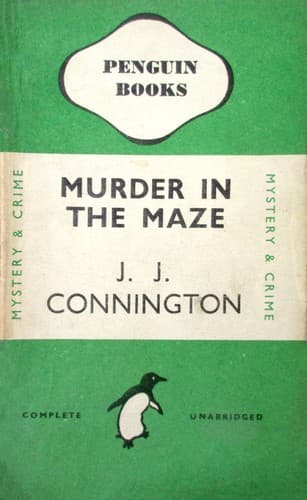
Country homes -- England -- Fiction; Detective and mystery stories; Murder -- Investigation -- Fiction
But when they had settled themselves in their easy chairs after
dinner, he found that Sir Clinton evidently intended to reverse the
rôles.
“Now then, Squire, _you’re_ under no restraint of official secrecy.
What do you make of the affair so far?”
“I see. I’m to be Watson, and then you’ll prove what an ass I am. I’m
not over keen.”
Sir Clinton hastened to reassure him.
“I’m not going to poke fun at you merely for the sake of making you
uncomfortable, Squire. It would really be some help if I could see the
thing from a fresh point of view. Lord knows, I’m not infallible; and
you may quite easily hit on something that’ll put a new light on
things and prevent me making a bad mistake.”
The obvious sincerity of this was enough to placate Wendover. He had
been cogitating deeply over the Whistlefield affair, and he felt that
if he could not suggest a provable solution of the mystery, at least
he could bring a reasonable amount of criticism to bear on the
available evidence.
“What we have to account for,” he began, “are: first, the murder of
the two Shandons; second, the burglary; third, the attack on Ernest
Shandon; and, fourth, the so-called hanky-panky with the cheque.”
“That’s correct,” Sir Clinton agreed. “But suppose we leave out the
cheque affair at present. We really know nothing definite about it
yet.”
Wendover was dissatisfied with this ruling.
“It seems to me an essential part in the scheme of things. Let me put
the case as I see it. Hackleton is at the back of the whole affair, I
take it; but he’s been employing an agent; and that agent has been
going beyond Hackleton’s instructions and has been operating on his
own to a certain extent. I think that fits everything in the case.”
Sir Clinton seemed inclined to dispute this conclusion, but he
restrained himself and merely nodded to Wendover to continue.
“I see your objection, I think,” the Squire went on. “You meant to
say: ‘Why were _both_ the Shandons murdered when it was only Neville’s
death that was essential to Hackleton?’ But there’s quite a plausible
explanation of that. You can’t hang a man twice. So if a man decides
to commit a single murder, he might as well commit two. The
punishment’s the same for a quantity. And if he can commit two with
equal impunity—as in the Maze—mightn’t it occur to him that two
murders would be a stiffer problem than one murder, in these
particular circumstances? Isn’t it the double murder that’s giving all
the difficulty? Of course it is. If either Shandon had been murdered
solus, we’d know at once the line to look up. But at present we don’t.
Now why shouldn’t the murderer have seen that very point and utilised
it?”
Sir Clinton nodded.
“That’s ingenious, Squire. I’m not ironical.”
Public-domain text, read in full here on John Shaqi.
Reviews
Reviews
No reviews yet
Be the first to share your thoughts on this work.
Elsewhere in the archive
Join the Discussion
Join the discussion
Sign in to leave a comment or review.
Sign InorCreate an account