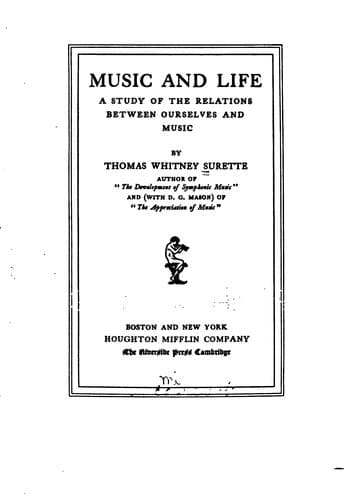
Music and Life: A study of the relations between ourselves and musicSurette, Thomas Whitney
History
Music and Life: A study of the relations between ourselves and music
Surette, Thomas Whitney
Music -- History and criticism
It has often been remarked that, in America, women have now both
leisure and independence to pursue the arts and to satisfy their desire
for what is called “culture,” and that in this respect they have taken
the place frequently occupied by men. The most characteristic element
in this situation is, however, that in the pursuit of intellectual or
artistic advancement, woman joins a club! These clubs are of very great
use to the individuals who belong to them and to the communities in
which they flourish when they undertake--as they frequently do--the
betterment of social conditions. Any one familiar with what they have
accomplished in this respect must pay them a real tribute. But in
their pursuit of “culture” they have been less successful, and for
the reasons already outlined here. They pursue too many subjects, and
they dissipate their energies. But above all, they seem unconscious
of the fundamental principle of education which is that one really
educates one’s self. For education, after all, consists in the gradual
enlargement of one’s own perceptions through coming in contact with
greater minds, and its processes are secret and intensely personal. As
you read “The Idiot,” for example, you connect Mishkin with Lohengrin,
Parsifal, the Arthurian legends, or even with Christ. The extraordinary
account of his thoughts as he falls in the epileptic fit, and his
use of the words, “And there was no more time,” bring up a whole
fascinating sequence of psychological speculations. The character of
Nastasya calls to your memory scores of other characters from Kundry
down to Sonia, and, as you read, the whole warp and woof of life, shot
through and through with its drab and scarlet, flashes before you.
Now, these contacts are as nothing if some one else makes them. The
spark must strike in your own imagination. You yourself must feel the
current of this magnetism which reaches from the earth to the stars
and makes all things akin. A good book should be a provocation to the
reader. A club for “culture” is a collection of human beings each
hoping for vicarious salvation through the other.
Women’s clubs not only waste energy in their pursuit of knowledge, but
they debilitate the intellectual strength of the individual woman.
Nothing could be worse for the mind than the peaceful acceptance of the
point of view of another without resistance and without the test of
your own thoughts and your own personality. Smatterings of knowledge
are almost useless. Nothing is yours until you make it so.
Public-domain text, read in full here on John Shaqi.
Reviews
Reviews
No reviews yet
Be the first to share your thoughts on this work.
Elsewhere in the archive
Join the Discussion
Join the discussion
Sign in to leave a comment or review.
Sign InorCreate an account