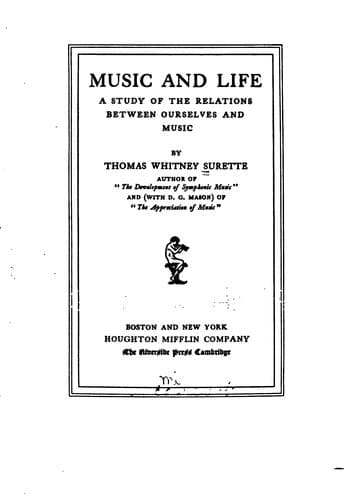
Music and Life: A study of the relations between ourselves and musicSurette, Thomas Whitney
History
Music and Life: A study of the relations between ourselves and music
Surette, Thomas Whitney
Music -- History and criticism
“I know not at what point of their course, or for how long, but it was
from the column nearest him, which is to be the first line, that the
King heard, borne on the winds amid their field music, as they marched
there, the sound of Psalms--many-voiced melody of a church hymn, well
known to him; which had broken out, band accompanying, among those
otherwise silent men.” So relates Carlyle, in “Frederick the Great,”
of the march of Frederick and his army before the battle of Leuthen.
“With men like these, don’t you think I shall have victory this day?”
says Frederick. Is not such singing a wonderful thing? Those soldiers,
with a common dedication to duty, and a common disdain of death, send
up to some dimly sensed Heaven, from the very depths of their being, a
song. How otherwise could they express the thoughts and feelings that
must have been clamoring for utterance in their sturdy breasts? Their
bodies were marching to battle. What of their souls? Shall the very
spirit of them slumber on their way to death?
And we? We watch from afar; we are dumb; we look on this profoundly
moving ceremony, this simple pageant, and utter nothing of what we feel
and what we are. Why do we not sing? Is it not partly because of that
self-consciousness which hangs about us like a pall, and partly because
we were never made to like singing well enough to pursue it? The former
difficulty we could overcome easily enough if the right opportunity
continually offered itself. The latter, too, would disappear as
occasion arose when we could sing something worth singing. “The
Star-Spangled Banner” is a candle-snuffer on the flame of patriotic
feeling; never was there an air more unsuited to its purpose. Since we
have almost no indigenous national melodies, why should we not sing the
old songs, chorals, and hymns that have survived all sorts of national
changes and belong to every people? The tune for “America” is not an
American tune, neither is it English. It originated in Saxony. There
is no nationalism to stand in the way of such music, because it speaks
elementally and universally. There are scores of fine melodies which we
could well use.
The one place where singing might be fostered is in church. But where
the worshipers are asked to sing a hymn pitched too high for them, or
one that moves too quickly, or is full of unfamiliar and difficult
progressions in both melody and harmony, what other result can be
expected than poor singing and the gradual abandonment of all music to
a paid choir? The real purpose of the hymn tune has been lost. It was
intended to serve the needs of all the people, and to do this it must
be simple in both melody and harmony, and within the range Of every
man, woman, and child in the congregation. The sturdy old hymns and
chorals of our forefathers were so. Nothing is finer in church music
than good unison singing in which every one takes part. No skilled
choir singing can ever take its place.
Public-domain text, read in full here on John Shaqi.
Reviews
Reviews
No reviews yet
Be the first to share your thoughts on this work.
Elsewhere in the archive
Join the Discussion
Join the discussion
Sign in to leave a comment or review.
Sign InorCreate an account