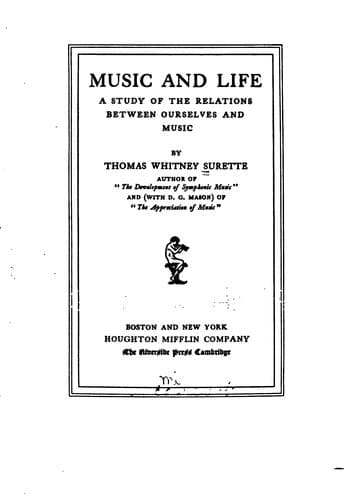
Music and Life: A study of the relations between ourselves and musicSurette, Thomas Whitney
History
Music and Life: A study of the relations between ourselves and music
Surette, Thomas Whitney
Music -- History and criticism
make-believe can deceive them.
And when I say this I mean that the experiment has been tried over and
over again. In what are called “the slums” of the greatest American and
English cities I have seen hundreds and even thousands of poor people
listening to the music of Beethoven, and to a few simple words about
it in rapt and tense silence, and have heard them break out into such
unrestrained applause as comes only from those who are really hungry
for good music. Put a good orchestra into any one of these places and
you will find the best kind of an audience. Such people have no taint
of hyper-criticism, no desire to talk wisely about the latest composer.
They have not constructed for themselves a nice little æsthetic formula
which will fit everything--a sort of protective coloring; their minds
are not “made up.”
Let us not misunderstand this situation. I am not writing about
painting or sculpture, for I know that these arts involve certain
perceptive and selective qualities of the mind which require long
training. I am writing about music, which appeals to a sense
differentiated and trained long before the sense for color-vibration or
for beauty of form was developed, a sense which we possess in a highly
developed state in very childhood.
Imagine a small opera house in the lower East Side of New York or in
the North End or South End of Boston, which the people there might
frequent at sums within their means; imagine a small Western city
with such an opera house; and compare the probable results with
those now attained by our gorgeous and needlessly expensive operatic
performances which, whether at home or abroad, leave little behind
them but a financial vacuum, and a dim idea that somehow opera means
famous “stars” singing in a highly exaggerated manner in a strange
language, in stranger dramas, where motives and purposes are stranger
still. Concerts and operatic performances such as I have advocated
would supplement and complete our own musical activities. These paid
artists would be playing and singing to us in a language we ourselves
had learned by using it. Music would be domestic; we should understand
it better and love it more.
I am familiar with the old argument that concerts and operas so
conducted would not pay. To this I reply that it is probably true. Does
settlement work pay? Does a library pay? Does any altruistic endeavor
anywhere pay? No; nothing of this sort ever shows a money balance
on the right side of the ledger. But we do not keep that column in
figures. It foots up in joy, not in dollars. The best kind of social
“uplift” would be something that made people happier. The real uplift
is of the soul, not of the body. Let a rift of beauty pierce the dull
scene. Let us have a taste of heaven now; and let it be not yours or
mine, but theirs. In music everybody makes his own heaven at the time.
Public-domain text, read in full here on John Shaqi.
Reviews
Reviews
No reviews yet
Be the first to share your thoughts on this work.
Elsewhere in the archive
Join the Discussion
Join the discussion
Sign in to leave a comment or review.
Sign InorCreate an account