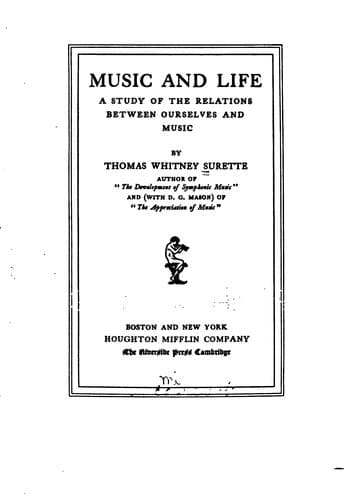
Music and Life: A study of the relations between ourselves and musicSurette, Thomas Whitney
History
Music and Life: A study of the relations between ourselves and music
Surette, Thomas Whitney
Music -- History and criticism
Its increasing costliness (due sometimes to the composer’s
grandiloquence and sometimes to the demands of the public) has
necessitated producing it in huge opera houses entirely unsuited to
it; and, being a mixed art, it has been subject to two different
influences which have not by any means always been in agreement. Its
life-line has been crossed over and over again by daring innovators
who, forgetting the past, have sought to force it away from nature and
to make it an expression of excessive individualism. Methods which
would find oblivion quickly enough in any pure form of art have been
carried out in opera, and have been supported by an uncritical public
pleased by a gorgeous spectacle or entertained by fine singing. All
the other art-forms progress step by step; opera leaps first forward,
then backward; it becomes too reasonable, only to become immediately
afterward entirely unreasonable; it passes from objectivity to
subjectivity and back again, or employs both at the same time; it turns
a man into a woman, or a woman into a man; it thinks nothing of being
presented in two languages at once; it turns colloquial Bret Harte into
Italian without the slightest realization of having become, in the
process, essentially comic: in short, there seems no limit to the havoc
it can play with geography, science, language, costume, drama, music,
and human nature itself.
Any attempt, therefore, to deal here with the development of opera as
a whole would be an impossible undertaking. We should become at once
involved in a glossary of singers (now only names, then in effect
constituting the opera itself), an unsnarling of impossible plots, an
excursion into religion, into the ballet, into mythology, demonology,
pseudo-philosophy, mysticism, and Heaven knows what else. We should see
our first flock of canary birds,--released simply to make us gape,--and
we should hear a forest bird tell the hero (through the medium of a
singer off the stage) the way to a sleeping beauty; we should hear the
hero and the villain sing a delightful duet and then see them turn away
in different directions to seek and murder each other; we should find
the Pyramids and the Latin Quarter expressible in the same terms; our
heroines would include the mysterious and demoniac scoffer, Kundry,
the woman who doubts and questions, the woman who should have but did
not, and the woman who goes mad and turns the flute-player in the
orchestra to madness with her; we should see men and women, attired
in inappropriate and even unintelligible costumes, drink out of empty
cups, and a hero mortally wound a papier-mâché dragon; we should have
to shut our eyes in order to hear, or stop our ears in order to see; if
we cared for music, we should have to wait ten minutes for a domestic
quarrel in recitative to finish; if we cared for drama, we should have
to wait the same length of time while a prima donna tossed off birdling
trills and chirpings. We should, in short, find ourselves dealing with
Public-domain text, read in full here on John Shaqi.
Reviews
Reviews
No reviews yet
Be the first to share your thoughts on this work.
Elsewhere in the archive
Join the Discussion
Join the discussion
Sign in to leave a comment or review.
Sign InorCreate an account