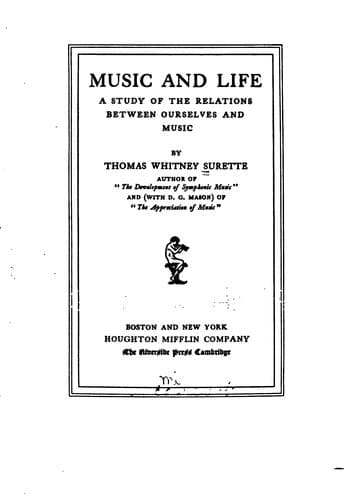
Music and Life: A study of the relations between ourselves and musicSurette, Thomas Whitney
History
Music and Life: A study of the relations between ourselves and music
Surette, Thomas Whitney
Music -- History and criticism
There had been composed before the year 1600 the most beautiful sacred
music the world possesses--that which culminated in the works of
Palestrina. A style or method of expression had been perfected, and
this style or method was gradually and naturally being applied to
secular and even to dramatic forms. There were at that time, also,
songs of the people which had been often used in plays with music, and
which might have supplied a basis for opera. But the creators of the
new opera would have none of these. They had a theory (fatal possession
for any artist): they wanted to revive the Greek drama, and they
believed that, in opera, music should be subservient to the text. It
was Peri and his associates who first saw this will-o’-the-wisp, which
has since become completely embodied into a fully equipped and valiant
bugaboo to frighten and subdue those who love music for music’s sake.
All that one needs to say on this point is that there is no great opera
in existence, save alone “Pelléas et Mélisande” by Debussy, in which
the music is not supreme over the text (and Debussy’s opera is unique
in its treatment and leads nowhere--or, if anywhere, away from opera).
Peri’s reforms were artistically unreasonable, but the composers who
followed him gradually evolved what is called the aria or operatic song
and did eventually make a more or less coherent operatic form, although
a long time passed before opera unified in itself the various elements
necessary to artistic completeness.
It was only a short time, however, before opera attained the widest
favor all over Europe, a favor which it has enjoyed from that day to
this. The reasons for this never-waning popularity are found first in
the natural preference on the part of the public for the human voice
over any instrument. For whatever facility of technique or felicity of
expression musical instruments may have, they lack the intimate human
quality of the singing voice. The voice comes to the listener in terms
of himself, whereas an instrument may be strange and unsympathetic and
awaken no response. So complete is this sympathy between the singer
and listener that almost any singer with a fine voice (she is, very
likely, called a “human nightingale”) is sure to attract an audience,
no matter what she sings or how little musical intelligence she shows.
(It is this sympathy, too, which inflicts on us the drawing-room song,
the last word in utter vacuity.) Coupled with this is the delight the
public takes in extraordinary vocal feats of agility. The singer vies
with a flute in the orchestra, or sings two or three notes higher than
any other singer has ever sung, and the public crowds to hear her. But
it is useless to dwell on this: the disease is incurable; there will
always be, I fear, an unthinking public ready for any vocal gymnast who
sings higher or faster than anybody else, or who can toss off trills
and runs with a smiling face and a pretty costume, and in entirely
unintelligible words.
Public-domain text, read in full here on John Shaqi.
Reviews
Reviews
No reviews yet
Be the first to share your thoughts on this work.
Elsewhere in the archive
Join the Discussion
Join the discussion
Sign in to leave a comment or review.
Sign InorCreate an account