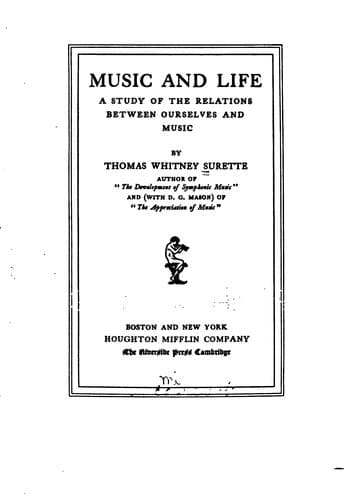
Music and Life: A study of the relations between ourselves and musicSurette, Thomas Whitney
History
Music and Life: A study of the relations between ourselves and music
Surette, Thomas Whitney
Music -- History and criticism
After Gluck came Mozart with his “Don Giovanni,” preserving the same
balance between action and emotion, with an even greater unity of
style and the same sincerity of utterance. Mozart possessed a supreme
mastery over all his material, and a unique gift for creating pure
and lucid melody. In his operas there is no admixture: his tragedy
and his comedy are alike purely objective--_and it is chiefly this
quality which prevents our understanding them_. We, in our day and
age, cannot project ourselves into Mozart’s _milieu_; the tragedy at
the close of “Don Giovanni” moves us no whit because it is devoid of
shrieking dissonances and thunders of orchestral sound. Our nervous
systems are adjusted to instrumental cataclysms. (We are conscious
only of a _falling_ star; the serene and placid Heavens look down
on us in vain.) Could we hear “Don Giovanni” in a small opera house
sung in pure classic style, we should realize how beautiful it is; we
should no longer crave the over-excitement and unrestrained passion
of “La Tosca”; we should understand that the deepest passion is
expressible without tearing itself to tatters, and that music may be
unutterably tragic in simple major and minor mode. Don Giovanni is a
type of operatic hero,--he may be found in some modified form in half
the operas ever written,--but Mozart lifts him far above his petty
intrigues and makes him a great figure standing for certain elements
in human nature. (It is the failure of Gounod to accomplish this which
puts “Faust” on the lower plane it occupies.) The stage setting of “Don
Giovanni,”--the conventional rooms with gilt chairs, and the like,--the
costumes, the acting, the music (orchestral and vocal), are all unified
in one style. And this, coupled with the supreme mastery and the
melodic gift of its composer, makes it one of the most perfect, if not
the most perfect, of operas.
Beethoven’s “Fidelio” (produced in 1805) celebrates the devotion
and self-sacrifice of a woman--and that devotion and self-sacrifice
actually have for their object _her husband_! It is a noble opera,
but Beethoven’s mind and temperament were not suited to the operatic
problem, and “Fidelio” is not by any means a perfect work of art. The
Beethoven we hear there is the Beethoven of the slow movements of the
sonatas and symphonies; but we could well hear “Fidelio” often, for it
stands alone in its utter sincerity and grandeur.
Public-domain text, read in full here on John Shaqi.
Reviews
Reviews
No reviews yet
Be the first to share your thoughts on this work.
Elsewhere in the archive
Join the Discussion
Join the discussion
Sign in to leave a comment or review.
Sign InorCreate an account