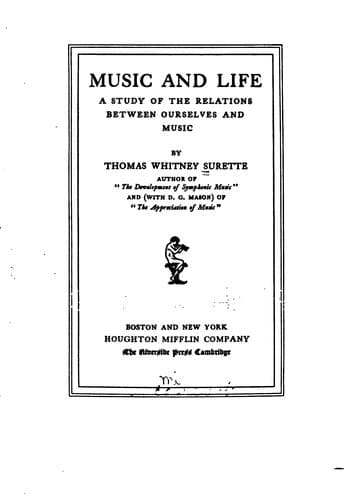
Music and Life: A study of the relations between ourselves and musicSurette, Thomas Whitney
History
Music and Life: A study of the relations between ourselves and music
Surette, Thomas Whitney
Music -- History and criticism
Wagner’s reforms were bound to bring about a reaction, which came in
due season and resulted in shorter and more direct works, such as those
of the modern Italians. No operas since Wagner, save Verdi’s “Otello”
and “Falstaff,” approach the greatness of his music-dramas, and the
tendency of many of these later works has been too much toward what we
mildly call “decadence.” But there is a great difference between the
truthfulness and artistic validity of “Carmen” and that of “La Bohème”
and “La Tosca.” The former is packed full of genuine passion, however
primitive, brutal, and devastating it may be; and its technical skill
is undoubted.
The most interesting phrase of modern opera is found in the works
of the Russians. It was inevitable that they should overturn our
delicately adjusted artistic mechanism. Dostoïevsky’s “The Brothers
Karamazov” is as though there never had been a Meredith or a Henry
James, and Moussorgsky’s “Boris Godounov” is as though there had never
been a Mozart or a Wagner. It has something of that amorphous quality
which seems to be a part of Russian life, but, on the other hand, it
has immense vitality. How refreshing to see a crowd of peasants look
like peasants, and to hear them sing their own peasant songs; and what
stability they give to the whole work! “Boris Godounov” gravitates, as
it were, around these folk-songs, which give to it a certain reality
and truthfulness.
V. OPERA AS A HUMAN INSTITUTION
These various works have long since been accepted by the musical
world as the great masterpieces in operatic form. Many of them are
practically out of the present repertoire of our opera houses. Were we
to assert ourselves--were the general public given an opportunity to
choose between good and bad--we should hear them often. And who shall
say what results might not come from a small and properly managed opera
house, with performances of fine works at reasonable prices?
Opera is controlled by a few rich men who think it a part of the
life of a great city that there should be an opera house with a fine
orchestra, fine scenery, and the greatest singers obtainable. It does
not exist for the good of the whole city, but rather for those of
plethoric purses. It does not make any attempt to become a sociological
force; it does not even dimly see what possibilities it possesses
in that direction. Opera houses and opera companies are sedulously
protected against any sociological scrutiny. They are persistently
reported to be hot-beds of intrigue; they trade on society and on the
love of highly paid singing; they surround themselves with an exotic
atmosphere in which the normal person finds difficulty in breathing,
and which often turns the opera singer into a strange specimen of the
_genus_ man or woman; they go to ruin about once in so often, and are
extricated by the unnecessarily rich; they are too little related to
the community that supports them save in the mediums of money and
social convention.
Public-domain text, read in full here on John Shaqi.
Reviews
Reviews
No reviews yet
Be the first to share your thoughts on this work.
Elsewhere in the archive
Join the Discussion
Join the discussion
Sign in to leave a comment or review.
Sign InorCreate an account