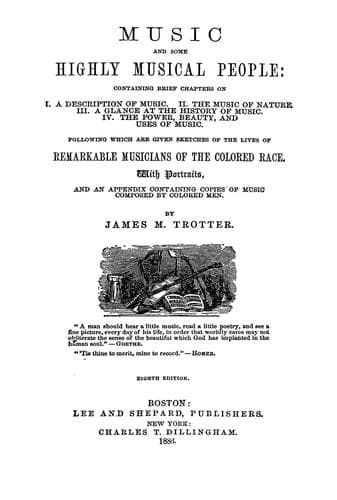
Music and Some Highly Musical PeopleTrotter, James M.
History
Music and Some Highly Musical People
Trotter, James M.
African American musicians -- Biography; African Americans -- Music
"Part third commenced with the 'Magic-wove Scarf,' from
Barnett's opera of 'The Mountain Sylph.' Barnett is a fine
composer, and was theoretically educated in Germany; and, on
his return, he composed the above opera. The musicians in
England were much surprised when this clever author left the
field of composition, after he had received such popularity
from his opera of 'The Mountain Sylph;' but the author was
obstinate, and I believe he was offended with some remarks
of the critics.
"The scene of the scarf is laid in Scotland. The mountain
sylph is a fairy, and falls in love with the tenor, a young
Scotchman. The baritone is a Scotch necromancer. The young
lover, fearful of losing his fairy love, appeals to this
demon for aid; and he, wishing to destroy the power of the
fairy, gives the young man the 'Magic-wove Scarf' to throw
around her. He told him that the scarf would secure her. He
was enticed, and threw the scarf around; but, the moment it
touched her, she became spell-bound, and is supposed to die,
but is released by a fairy of superior power.
"The trio opens with a fine baritone solo; and, considering
Mr. Hyers is not a professional singer, the part was
creditably rendered.
"The tenor, Miss Emma, conveyed the author's meaning truly;
and her imitation of that voice took her to the F sharp
below the staff. This note was intoned with perfect ease.
"In Miss Anna's part there are some beautiful rouladial
passages, which were delivered by the young lady smoothly
and distinctly; and, when she became spell-bound by the
scarf, her _espressivo_ and _energico_ were fine.
"The trio throughout was creditably performed, and was
loudly applauded by the audience.
"'Brighter than stars soft gleaming,' from the opera 'Il
Trovatore,' is a fine composition abounding in _espressivo_
and _bravura_ passages: the compass is also extensive,
requiring great range for a baritone voice. The piece was
rendered with credit by the young vocalist Le Count.
"A very choice selection from Donizetti's opera of 'Lucia di
Lammermoor' followed, and was sung by Miss Anna Hyers. The
first line of the English words is, 'See, 'tis the hour: how
sinks the sun!' The whole of this movement is in the
_affetturoso con amoroso_ [Transcriber's Note: affettuoso
e amoroso] style; and in order to render such a theme
effective, as love without hope, but still hoping, the
singer must throw a vast amount of pathos into the subject
to secure a fine interpretation; which rendition by the
artist was all that could be required. The second movement
is in D major. The words of the principal line are, 'Grow
dark, yes, love's pure flame grow dark, like earthly fire.'
Public-domain text, read in full here on John Shaqi.
Reviews
Reviews
No reviews yet
Be the first to share your thoughts on this work.
Elsewhere in the archive
Join the Discussion
Join the discussion
Sign in to leave a comment or review.
Sign InorCreate an account