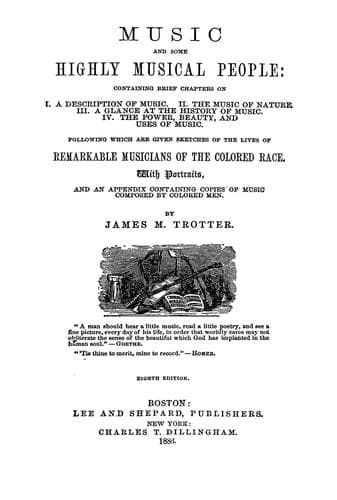
Music and Some Highly Musical PeopleTrotter, James M.
History
Music and Some Highly Musical People
Trotter, James M.
African American musicians -- Biography; African Americans -- Music
I believe I have already intimated that the very high esteem in which
Miss Brown is held arises not alone from her possession of charming
lyric qualities, but also from her obliging disposition and engaging
manners. She has ever been the true artist; earnestly devoted to the
fullest development of her own musical powers, but not envying those
of others; loving music intensely, as something sacred, and always
anxious to aid in extending its benign influence. The people of Dover,
of Haverhill, of Boston, and other places, hold her in grateful
remembrance for a frequent exercise of those generous impulses that
have caused her to often sing without charge at concerts given for the
benefit of many good objects.
As one among her many acts to benefit the young, to inspire them with
a love of the beautiful in music, I may refer to the "Centennial
Musical Festival" originated by her, and given under her direction in
Boston on the evenings of May 16 and 17, 1876. For these occasions she
had carefully instructed fifty young girls to perform the beautiful
cantata of "Laila, the Fairy Queen," a juvenile operetta. This
charming composition is admirably adapted to inspire a love of the
beautiful in art, and to nurture sentiments of Christian kindness. The
following is in brief the plot:--
"A band of mountain children are collected to spend the
summer day in singing, gathering flowers, and feasting
around their table spread beneath the shadowy branches of
the trees. They are interrupted by the approach of a
beggar-woman and her children. A part of the children at
first repulse her, offended at having their joyous festival
thus interrupted: but one of them, Laila, steps forth with a
mild rebuke to her playmates for their unkindness: she
welcomes the poor mother and children, and bids them make
known their wants. The other children soon join with Laila
in speaking kindly to the poor wanderers; and, after they
have told them their tale of sorrow, they are invited to the
feast which the children have prepared, and all together go
out with a merry song to where the table is spread. But
Laila, the favorite of all, wandering off alone to cull some
wild flowers, in the ardor of her search loses her way, and
wanders about until night approaches; and then, as weary and
frightened she finds herself in a dark forest, she kneels to
ask aid from her good angel, when suddenly a little band of
fairies with their queen glide into her presence, glittering
in their robes of beauty; and, after her surprise is over,
at her entreaty they conduct her to her playmates.
Public-domain text, read in full here on John Shaqi.
Reviews
Reviews
No reviews yet
Be the first to share your thoughts on this work.
Elsewhere in the archive
Join the Discussion
Join the discussion
Sign in to leave a comment or review.
Sign InorCreate an account