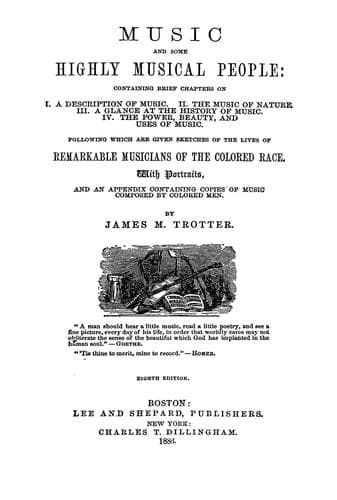
Music and Some Highly Musical PeopleTrotter, James M.
History
Music and Some Highly Musical People
Trotter, James M.
African American musicians -- Biography; African Americans -- Music
But the music of which I have been speaking was never cradled, so to
say, in the lap of science; although, in its strangely-fascinating
sweetness, soulfulness, and perfect rhythmic flow, it has often quite
disarmed the scientific critic. It is a kind of natural music. Until
quite recently no attempt was made to write it out, and place its
melodies upon the printed music-page. Slavery, of course, prevented
that. And this vile system, although it could not stamp out the
"vocal spark," the germ of great musical ideas, could still prevent
such growth of the same, such elaboration, as would have been secured
by education in a state of freedom. Yet, since the war, many of the
religious slave-songs of the South, words and music, have been
printed. It has been found that they are as subject to the laws of
science as are others; that they were not, as many persons have
supposed, merely a barbarous confusion of sounds, each warring, as it
were, against the other. For a proof of this (if there be those who
doubt), the reader is referred to the "History of the Jubilee Singers
of Fisk University," in which he will find printed the music of many
songs like those to which I have alluded.
Thus have we considered, in part, the native minstrelsy of the South.
Notwithstanding their lack of a scientific knowledge of music, colored
men, as instrumentalists, have long furnished most of the best music
that has been produced in nearly all of the Southern States. At the
watering-places, orchestras composed of colored musicians were always
to be found; in fact, at such places their services were considered
indispensable. Many of them could not read music; but they seemed
naturally full of it, and possessed a most remarkable faculty for
"catching" a tune from those of their associates who learned it from
the written or printed notes: in truth, the facility of all in
executing some of the most pleasing music in vogue was so great, that,
when these little orchestras played, it was almost impossible to
discover the slightest variation from the music as found on the
printed page.
Public-domain text, read in full here on John Shaqi.
Reviews
Reviews
No reviews yet
Be the first to share your thoughts on this work.
Elsewhere in the archive
Join the Discussion
Join the discussion
Sign in to leave a comment or review.
Sign InorCreate an account