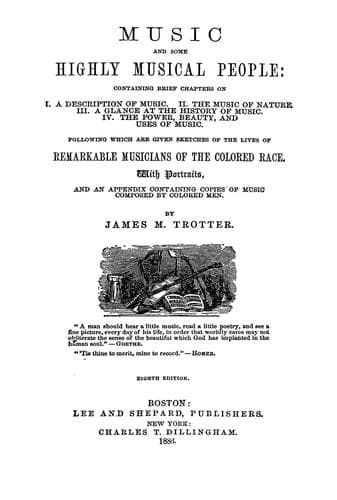
Music and Some Highly Musical PeopleTrotter, James M.
History
Music and Some Highly Musical People
Trotter, James M.
African American musicians -- Biography; African Americans -- Music
"By Music, minds an equal temper know,
Nor swell too high, nor sink too low.
If in the breast tumultuous joys arise,
Music her soft, assuasive voice applies,
Or, when the soul is pressed with cares,
Exalts her in enlivening airs;
Warriors she fires with animated sounds;
Pours balm into the bleeding lover's wounds;
Melancholy lifts her head;
Morpheus rouses from his bed;
Sloth unfolds her arms, and wakes;
Listening Envy drops her snakes;
Intestine war no more our passions wage;
And giddy factions bear away their rage....
Music the fiercest grief can charm,
And Fate's severest rage disarm;
Music can soften pain to ease,
And make despair and madness please;
Our joys below it can improve,
And antedate the bliss above."
APPENDIX.
MUSIC.
PREFACE TO THE MUSIC.
It is deemed necessary to offer a few words of explanation touching
the music printed on the following pages.
The collection is given in order to complete the author's purpose,
which is not only to show the proficiency of the subjects of the
foregoing sketches as interpreters of the music of others, but,
further, to illustrate the ability of quite a number of them (and,
relatively, that of their race) to originate and scientifically
arrange good music.
For want of space, only a few selections have been made from the many
compositions in the writer's possession; and, for the same reason,
only parts of several works, somewhat elaborate in character, have
been given; the latter curtailment having been made in the cases of
the following: "The Pilgrim" (a grand overture, originally occupying
about twenty pages, sheet-music size), only one-third of which appears
in this collection; of an elegant arrangement of the air of "Au Clair
de la Lune" (containing Introduction, Theme, First, Second, and Third
Variations, and Finale), only the "Theme" and Third Variation are
given; of the Parisian Waltzes (a set of five), only the introduction,
coda, and Waltz No. 3 are given; of "Les Clochettes,"--fantaisie
mazurka,--only a part appears; and so of "La Capricieuse;" while, of
the "Mass," only two movements appear, the "Gloria" and "Agnus Dei."
The attention of all who shall examine the music is particularly
called to the above statements, in order that there may be no
surprises, and no injustice done the composers.
In two instances only have very long compositions been reprinted in
full. The first (the "Anthem for Christmas") is so given as a mark of
respect to the memory of a pioneer musician, now deceased; and the
second ("Scenes of Youth"), because a different treatment would
seriously interrupt a continuous description which has been so vividly
given by a young and talented composer.
The author of "Welcome to the Era March" is less than eighteen years
old. The author of "Rays of Hope" has just attained to his majority.
Public-domain text, read in full here on John Shaqi.
Reviews
Reviews
No reviews yet
Be the first to share your thoughts on this work.
Elsewhere in the archive
Join the Discussion
Join the discussion
Sign in to leave a comment or review.
Sign InorCreate an account