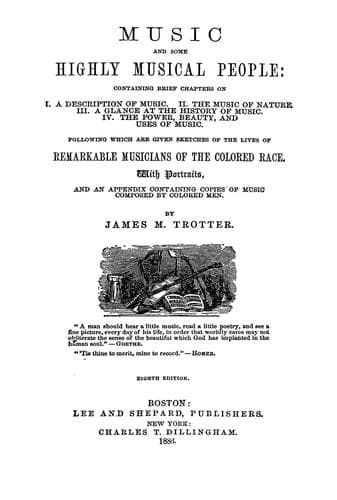
Music and Some Highly Musical PeopleTrotter, James M.
History
Music and Some Highly Musical People
Trotter, James M.
African American musicians -- Biography; African Americans -- Music
As stated in the extract just quoted, Mr. Williams, before being
accepted as a member of the Jubilee orchestra, was subjected to a
severe test; being required to execute on the double-bass the parts
written for that instrument in the celebrated overture from "William
Tell," and also in Wagner's difficult "Tannhaeuser." In regard to this
test Mr. Baldwin has since said to the writer, "I myself had no doubts
as to Mr. Williams's ability as a musician. My object in arranging the
test performance was, that I might afterwards point to its successful
result, and thus silence many of the instrumentalists that came from
other parts of the country, in case they should object (I knew that
many of them would do so), on the weak ground of _color_, to playing
with Mr. Williams. Neither Mr. Gilmore nor myself knew any man by the
color of his face. What we wanted for the grand orchestra was _good
musicians_, and, when any one objected to our two colored performers,
we triumphantly referred to the exacting and satisfactory test they
had undergone as sufficient answer to the foolish clamors of all those
afflicted with 'color-phobia.' Seeing the managers of the Jubilee thus
resolved, and convinced that the two colored men were artistic
performers,--superior in ability to many with whom they were to be
associated,--no one declined to play; and all was harmony thereafter."
And here I may be permitted to record the thanks of all well-meaning
people for the noble action of Messrs. Gilmore and Baldwin. The two
artists mentioned were not the only members of their race who took a
part in the memorable Jubilee concerts. Several others in a vocal way
occupied even prominent positions at these concerts. Some sang as
artists on the stage, and several were members of that great chorus of
nearly twenty thousand voices. In all these places they did their
share in making the occasion a grand success, while they justified
fully the wisdom of those by whom they were invited to participate.
The action of the latter was no more than what was due and right, it
is true; but it is well to remember (for we must take things as we
find them) that Messrs. Gilmore and Baldwin were not obliged to engage
these persons. Had the former not been men of pure principles and
firmness, they might have yielded to the mean and by far too popular
prejudice entertained against colored people, and have refused to
allow them to take part in the performances. That they did not thus
yield is much to their credit as musicians and gentlemen; and they are
to be thanked, I say, for their manly action.
Public-domain text, read in full here on John Shaqi.
Reviews
Reviews
No reviews yet
Be the first to share your thoughts on this work.
Elsewhere in the archive
Join the Discussion
Join the discussion
Sign in to leave a comment or review.
Sign InorCreate an account