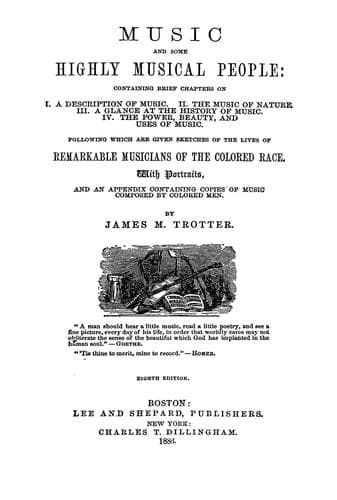
Music and Some Highly Musical PeopleTrotter, James M.
History
Music and Some Highly Musical People
Trotter, James M.
African American musicians -- Biography; African Americans -- Music
Some time after the publication of the method just mentioned, the
Messrs. Brainard engaged Mr. Holland to write a somewhat similar one,
but smaller in size, for them. This they issued in 1876, it being
styled "Holland's Modern Method for the Guitar." Although smaller in
size than the first one, it is regarded as the best method for
beginners that has as yet been produced.
It may perhaps be interesting to those possessing a scientific
acquaintance with the guitar, as well, indeed, as to the general
student of music, to learn how this accomplished author acquired the
power to so clearly--more clearly than it was ever before done in
guitar books--explain the method of producing on the guitar the
_harmonic tones_. Writing a friend, Mr. Holland thus speaks of this:--
"When, in writing my first book, I came to the subject
'Harmonics,' I found myself at a loss as to how to explain
these tones; not as to how to produce them myself, but to
give a correct _theory_ of their production. I searched in
vain through a multitude of musical works, not knowing or
thinking of anywhere else to look. I stopped for several
weeks, and began a series of observations on the vibrations
on the strings of my guitar; having nothing to aid me but my
eyes, fingers, and ears, and a knowledge of the fact that
the vibrations of a string were doubled in number for every
octave of ascent in pitch of tone. I thus discovered the
true theory of the harmonic tones to be the vibrations of a
single string in a number of equal sections, more or less,
and all at the same time; and that their production was at
the pleasure of the operator as he desired higher or lower
tones. Having fully verified my discoveries, I then
corrected the erroneous theory on this subject of the great
guitarist, F. Sor. I learned afterwards that the subject was
discussed and explained in some scientific works that
treated on acoustics."
I have before referred to the pecuniary disadvantages under which Mr.
Holland had to labor in the beginning of his career. These followed
him for a long period. It seems that much time must nearly always
elapse ere even genius becomes acknowledged, and its possessor
receives that pecuniary reward so necessary to his support. This
acknowledgment, and, to an encouraging extent, this substantial
reward, came to Mr. Holland after a while, but not until after he had
passed through many very trying scenes. One of the latter has been
thus described:--
Public-domain text, read in full here on John Shaqi.
Reviews
Reviews
No reviews yet
Be the first to share your thoughts on this work.
Elsewhere in the archive
Join the Discussion
Join the discussion
Sign in to leave a comment or review.
Sign InorCreate an account