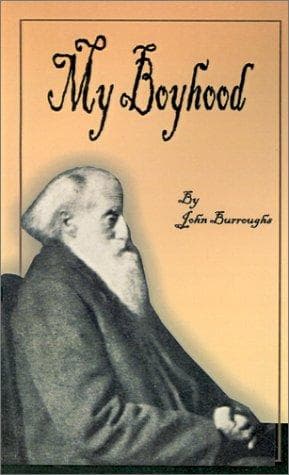
Burroughs, John, 1837-1921 -- Childhood and youth; Naturalists -- New York (State) -- Biography
In this case I know that time and distance lend enchantment, for of the
hard work in the vineyards Father did very little--the cultivating with
a horse on days so hot that the horse was covered with lather and the
dust rose in a cloud over one's perspiration-soaked clothes, the days
following the spray cart with the lime and blue vitriol flying in one's
face and running down one's legs, the tying in March and early April
until one's fingers were raw and one's neck ached from reaching up--of
all these and other tasks he knew nothing. Often he said of himself that
he was lazy; and, though what he accomplished in his life stands like
a monument in one sense of the word, he was lazy. Routine work, a daily
grind at tasks for which he had no liking, would have shortened his days
and perhaps even embittered him. Yet with what eagerness he went at
his writing! For sixty years and over he found his greatest joy in his
craft--as he once wrote me, "There is no joy like it, when sap runs
there is no fun like writing." As he said of his books in a preface to
a new edition, "Very little real 'work' has gone into them." One day out
at La Jolla, California, up on the hillside overlooking the blue Pacific
there was a gathering in one of the biological laboratories and the
school children came trooping in. Father was asked to talk to them and
among other things he asked them if a bee got honey from the flowers.
"No," he said, "the bee gets nectar from the flower, a thin sweetish
liquid which the bee, by processes in its own body, turns into honey."
I have always suspected that Father liked to think of himself as a
bee, out in the sunshine and warmth, in the fields and woods, among
the flowers, gathering delightful impressions of it all which with his
handicraft he could preserve in an imperishable form that others might
also enjoy. And does a bee really work? Is it not doing exactly what it
enjoys or wants to do? Does it have to make any conscious effort to fare
forth among the flowers? Does it have to keep on doing what it dislikes
to do long after it is tired out? So whether the life of John Burroughs
was one long life of happiness and lazy play, or whether it was one of
hard work, depends, like so many other things, on the point of view. I
like to think of his long and happy life as one in which he turned all
work to play, and in so doing he accomplished mightily.
Public-domain text, read in full here on John Shaqi.
Reviews
Reviews
No reviews yet
Be the first to share your thoughts on this work.
Join the Discussion
Join the discussion
Sign in to leave a comment or review.
Sign InorCreate an account