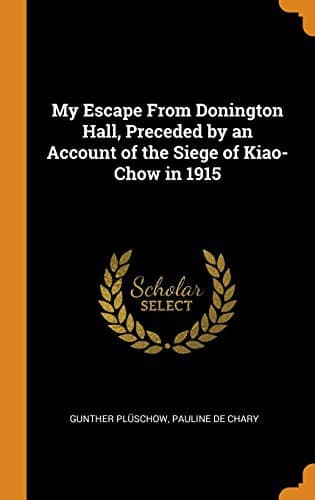
My Escape from Donington Hall, Preceded by an Account of the Siege of Kiao-Chow in 1915Plüschow, Gunther
History
My Escape from Donington Hall, Preceded by an Account of the Siege of Kiao-Chow in 1915
Plüschow, Gunther
Prisoner-of-war escapes; World War, 1914-1918 -- Personal narratives, German; World War, 1914-1918 -- Prisoners and prisons, British
How many times already had I sailed past this Rock, how often had I,
returning from foreign parts, tendered joyous welcome to the grey
stones, the sign-post, in these straits to the faithful homeland! What
was in store for me this time? In spite of the fact that the time-table
made no provision for calling at Gibraltar, the ship entered the port
for examination, without even awaiting a request to do so, and dropped
anchor. To this extent had the Italians already become the slaves of
the English! As soon as the ship lay to, two pinnaces descended upon
us, from which emerged an English naval officer and sundry policemen
and sailors armed to the teeth. A bell was sounded all over the ship,
with the order that all foreign passengers, who were neither English
nor Italian, should assemble on the pilot bridge. The Italian stewards
went below, inspected the ship’s hold and all the cabins, and drove
us like a herd of sheep to the upper deck, where we were closely
surrounded by them and the English sailors. I cannot pretend that I
felt particularly happy! In spite of this I experienced a certain
amount of confidence, as I soon found out that I was the only one
equipped with a genuine passport and photograph. On the other hand, I
established the fact that we were five Swiss, three of whom had already
excited my suspicion on account of their shy and retiring disposition.
There was only one whom I had not noticed at all, and he looked so
dirty and repulsive that I took the precaution of moving away when he
placed himself beside me. After an hour, during which the first-class
passengers were examined—casually, and with great politeness—our turn
came. We stood there like six miserable sinners. The first one was an
Italian-Swiss workman, who had lost his right arm. His wife, a typical
Italian, prostrated herself wailingly at the Englishman’s feet. She
was accompanied from the steerage by her whole tribe, and they _all_
wailed. The Englishman looked contemptuously at those people, and after
a short examination the man was dismissed and free to go. We had now
to advance. The tallest amongst us Swiss stood on the right wing. The
English officer went up to him and said: “You are a German officer.”
Violent and indignant protestations naturally followed; but the English
officer, whom they left quite cool, ordered him aside and turned to
us—we seemed more like the genuine article in his sight. We pointed
to our passports, and each one of us dished up a wondrous yarn. After
a short pause he said: “All right; these four can go, but I will keep
that one.”
Public-domain text, read in full here on John Shaqi.
Reviews
Reviews
No reviews yet
Be the first to share your thoughts on this work.
Join the Discussion
Join the discussion
Sign in to leave a comment or review.
Sign InorCreate an account