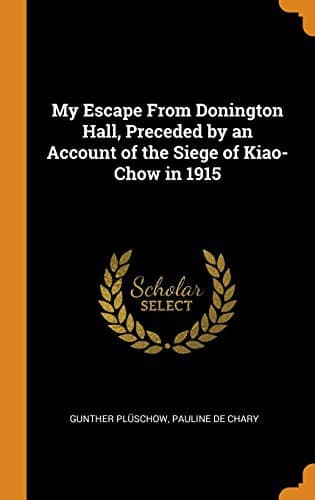
My Escape from Donington Hall, Preceded by an Account of the Siege of Kiao-Chow in 1915Plüschow, Gunther
History
My Escape from Donington Hall, Preceded by an Account of the Siege of Kiao-Chow in 1915
Plüschow, Gunther
Prisoner-of-war escapes; World War, 1914-1918 -- Personal narratives, German; World War, 1914-1918 -- Prisoners and prisons, British
My heart was throbbing with joy, but, alas, then appeared the Judas.
A young fellow, in perfectly fitting civilian clothes, went up to
the officer and spoke to him in raised tones. “It is quite out of
the question that these people should be allowed to leave without
having all their belongings thoroughly searched. I am convinced they
are Germans.” We exclaimed loudly at this, but to no end, though the
English officer obeyed this blackguard with evident reluctance and
contempt. However, the examination took place. Everything was turned
upside down. The rascal ferreted about everywhere, but seemed unable
to find any incriminating marks on any of our belongings. Suddenly he
whipped round, tore open my coat, turned out my breast-pockets and said
triumphantly to the officer who stood at his side, “You see, there is
neither a name nor a monogram. It is a sure sign that he is a German,
and that he has destroyed all initials.” Oh, if I could but have
brained the reptile!
As we were soon to learn, this civilian was the representative of the
firm of Thomas Cook Brothers in Gibraltar, and acted on the ships in
the dual capacity of d—— spy and interpreter. His German was so
pure that he must have enjoyed our hospitality in Germany for many
years. How many wretched creatures probably owe their undoing to this
busybody!
Once more we five were driven on deck like cattle. At this moment Judas
number two appeared, who had been fetched by Cook’s agent. This was a
first-class Swiss passenger, and at the instigation of the arch-sneak
he was to try us in Swiss dialect. Of course we all failed miserably.
Our protests were useless. Not even when I told them the wildest tales
about knowing no German, as I had left Switzerland with my parents when
a child of three, and had settled with them in Italy, and that after
that I had drifted to America. I talked nineteen to the dozen in good
Italian and American, and I nearly succeeded; but the snake hissed
again—and my hopes were dashed to the ground.
The English officer refused us any further hearing; but only remarked
that more Swiss had passed through Gibraltar than there were in the
whole world. Bursting with a frenzy that bordered on madness, I was led
away. I quickly gathered my few traps and was able unobserved to slip
a scrap of paper into a German lady’s hand, which she later faithfully
delivered to my relatives. A sailor rudely propelled me down the
gangway into the pinnace, where the other poor wretches already sat,
completely crushed. On the arrival of the English officer with his
minion we started.
The Swiss traitor stood at the breast-rail of the ship and grinned
gloatingly at us. Thereupon I was unable to contain myself any longer,
but jumped up and shook my fist at him, yelling out an invective.
Hysterical, treacherous laughter sounded back.
But a pair of German eyes sent me a sad farewell from starboard.
Good-bye, oh, happy comrade! Greet for me the Fatherland you will see
again in a few days.
Public-domain text, read in full here on John Shaqi.
Reviews
Reviews
No reviews yet
Be the first to share your thoughts on this work.
Join the Discussion
Join the discussion
Sign in to leave a comment or review.
Sign InorCreate an account