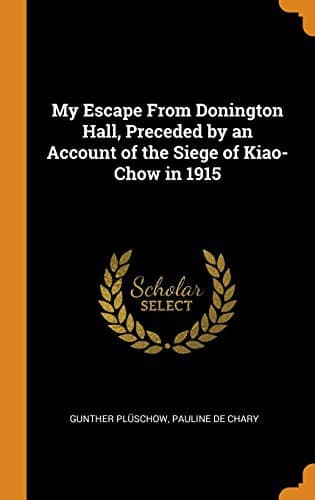
My Escape from Donington Hall, Preceded by an Account of the Siege of Kiao-Chow in 1915Plüschow, Gunther
History
My Escape from Donington Hall, Preceded by an Account of the Siege of Kiao-Chow in 1915
Plüschow, Gunther
Prisoner-of-war escapes; World War, 1914-1918 -- Personal narratives, German; World War, 1914-1918 -- Prisoners and prisons, British
In the beginning, I thought myself in Paradise, the more so as I was
again being treated as a human being. I was once more amongst my
comrades, and found my old friends, and was greatly stimulated thereby.
The treatment in the camp was good. The English Commandant was a
sensible man, who tried to ease our existence. The building was
an old military school, and 100 officers were imprisoned in the
camp—eight to ten shared a dormitory, which was at the same time a
sitting-room. Apart from this, there was a number of mess, reading
and dining-rooms, in which we spent most of our time when we were
not in the fresh air. The food was purely English, therefore hardly
palatable to the majority of the Germans, but more than sufficient and
of good quality. At the beginning we managed our own mess; but this,
unfortunately, was forbidden later on by the War Office. During the day
we were left comparatively alone. We were allowed to move freely among
the buildings, and in the garden. At ten in the morning there was
roll-call, and at ten in the evening “lights out” and rounds.
Of course we were not allowed to approach the barbed-wire entanglements
which surrounded the whole place, and which were strictly guarded and
illuminated night and day. Twice a day the gates were opened, and we
passed between a lane of English soldiers to the sports ground, which
lay about 200 yards away. Our games were wonderfully organized. Two
splendid football, and, above all, some perfect hockey-fields, stood at
our disposal, and we displayed such amazing form that even the English
were impressed. It is superfluous to add that these fields were also
surrounded by barbed wire and sentries.
A very pleasant feature was the bi-weekly appearance of an excellent
tailor, and also of a haberdasher, who provided us with excellent
hosiery and gave us the opportunity of renewing our wardrobe.
Our monthly pay amounted to 120 marks, of which sixty was put aside for
our keep. We were permitted to spend the rest; also to receive money
from home. The post worked without a hitch. Letters from Germany, as
well as parcels, took from six to eight days, and arrived regularly.
Conditions were less fortunate in regard to our own correspondence. Our
weekly allowance consisted of two short notes, and how gladly would
we have filled reams to our dearest at home! The post was the Alpha
and Omega of our existence. We divided our whole day according to its
delivery, and the temper of the camp was regulated by it.
Public-domain text, read in full here on John Shaqi.
Reviews
Reviews
No reviews yet
Be the first to share your thoughts on this work.
Elsewhere in the archive
Join the Discussion
Join the discussion
Sign in to leave a comment or review.
Sign InorCreate an account