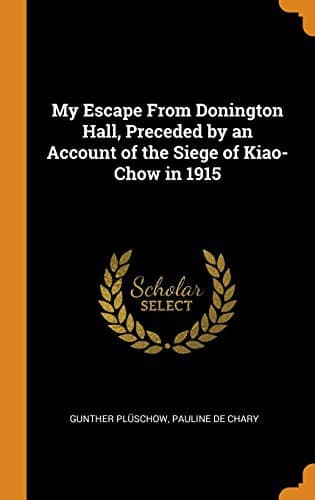
My Escape from Donington Hall, Preceded by an Account of the Siege of Kiao-Chow in 1915Plüschow, Gunther
History
My Escape from Donington Hall, Preceded by an Account of the Siege of Kiao-Chow in 1915
Plüschow, Gunther
Prisoner-of-war escapes; World War, 1914-1918 -- Personal narratives, German; World War, 1914-1918 -- Prisoners and prisons, British
One evening, towards the end of June, we had a delightful adventure.
Outside the barbed wire a herd of wild deer—roebucks and fawns—used
to assemble in their hundreds, and ran about as tame as goats.
That evening, a darling little fawn, which had lost its mother, ran
past the wire fence, and, attracted by our alluring calls, it cleverly
wriggled through the defences into the camp. The fawn was surrounded
and petted (the huntsmen growled), and lastly it was carried in triumph
in the arms of a Lieutenant into the batmen’s room, where we intended
to rear it.
God knows how M—— heard of it. At any rate he sent for the German
Camp Adjutant, and said in a voice that shook with anxiety:
“Lieutenant S., is it true that there is an animal in the camp?”
“Yes, sir; an animal.”
“Has it come in through the wire entanglements?”
“Yes; it simply crept through.”
“Oh, this is dreadful!” remarked Mr. M——, and he seemed to lose his
voice altogether. “I must at once see the hole through which the big
beast has crawled. I am convinced that the German officers have cut the
wire in order to escape. The animal must also be at once removed.”
And so it happened.
And—this is no joke—twenty men from the guard with fixed bayonets
were sent for. The solitary German soldier with the innocent tiny
fawn was taken into their midst. On the order “Quick march” the whole
procession moved to the inside door of the fence. The latter was
opened, the twenty men with the German soldier and the fawn stepped
into the intervening space, the so-called “lock,” the inner portal,
was carefully shut. Only then was the outer one opened, the soldier
liberated the fawn, and after that the whole procession wended its way
back. Oh, Mr. M—— what a laughing stock you made of yourself!
After that all the entanglements were carefully examined, and, though
it was impossible to find the smallest cleft through which a man could
have crept, M—— could not quiet down for days.
Apart from the post, the arrival of newspapers represented the chief
interest of the day. We were allowed to receive the _Times_ and the
_Morning Post_, and, though they were nearly exclusively filled with
Entente victories, we knew them so well after a short time that we
could read between the lines, and were able to conjecture the real
state of affairs with approximate correctness.
But what rage in the newspapers at the sinking of the _Lusitania_,
and what anger when the Russians had to retire—of course only for
strategic reasons! We had manufactured for ourselves several huge
maps of the theatres of war, which were correct even to the slightest
details, and each morning at eleven our “General Staff Officers” were
hard at work moving the little flags. Often the English Colonel himself
stood in front of them and thoughtfully shook his head.
CHAPTER XII
THE ESCAPE
Public-domain text, read in full here on John Shaqi.
Reviews
Reviews
No reviews yet
Be the first to share your thoughts on this work.
Elsewhere in the archive
Join the Discussion
Join the discussion
Sign in to leave a comment or review.
Sign InorCreate an account