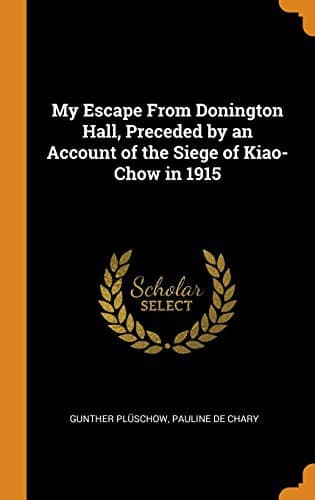
My Escape from Donington Hall, Preceded by an Account of the Siege of Kiao-Chow in 1915Plüschow, Gunther
History
My Escape from Donington Hall, Preceded by an Account of the Siege of Kiao-Chow in 1915
Plüschow, Gunther
Prisoner-of-war escapes; World War, 1914-1918 -- Personal narratives, German; World War, 1914-1918 -- Prisoners and prisons, British
Next we were confronted by a wire obstacle, 3 feet high by 30 feet
wide, contrived according to the latest and most cunning devices. We
ran over it like cats. After this we again came to a high barbed-wire
hedge, built on exactly the same lines as the first, and also
electrically charged. We managed this too, except that I tore a piece
out of the seat of my trousers, which I had to retrieve, in order to
put it in again later.
But, thank God, we were over the boundary!
Trefftz and I clasped hands and looked at each other in silence.
But now the chief difficulty began. Cautiously we went forward in the
darkness, crossing a stream, climbing over a wall, jumping into a
deep ditch, and at last slunk past the guard-house which stood at the
entrance to the camp. Only after that were we in the open.
We ran without stopping along the wide main road which led to Donington
Castle. After half an hour we stopped and took off our leggings and
gloves, which had been slashed and torn by the wire. The palms of our
hands, our feet, to say nothing of other parts of our body, were in a
pretty condition. The barbed wire left us souvenirs which stung for
weeks.
We now opened our bundles, took out civilian grey mackintoshes, and
walked down the road in high spirits as if we were coming from a late
entertainment. When Donington Castle came in sight, we had to be
particularly careful. We had agreed upon all we would do in case we met
anyone.
Suddenly, just as we were turning into the village, an English soldier
came walking towards us. Trefftz embraced me, drew me towards him,
and we behaved like a rollicking pair of love-birds. The Englishman
surveyed us enviously, and went on his way, clicking his tongue. Only
then, something in the stocky, undersized figure made me realize that
it was the sergeant-major of our camp! We stepped out briskly, and
after passing the village we were favoured by chance, and came upon the
bridge about which we had been told. But we were at once confronted
with a critical proposition. The highway branched off here in three
directions, and it was impossible to get any farther without knowledge
of the road. At last, in spite of the darkness, we discovered a
sign-post—an extreme rarity in England. Luckily it was made of iron,
and, when Trefftz had climbed it, he was able to feel with his fingers
the word “Derby” traced on it in raised letters.
Public-domain text, read in full here on John Shaqi.
Reviews
Reviews
No reviews yet
Be the first to share your thoughts on this work.
Elsewhere in the archive
Join the Discussion
Join the discussion
Sign in to leave a comment or review.
Sign InorCreate an account