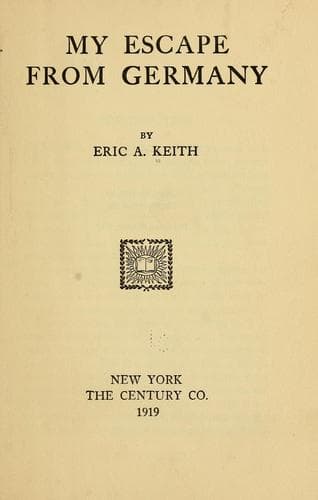
Prisoner-of-war escapes; World War, 1914-1918 -- Prisoners and prisons, German
Potato-vines offer very good cover for a man in a prone position. It
was dark, too. But, lying there, I had the uncomfortable feeling that
some large and conspicuous part of my anatomy must be sticking out
into plain view. I flattened myself as much as possible and vainly
tried to decrease my bulk by general muscular contraction, but seemed
to swell to ever greater dimensions. When I lifted my head after some
time I saw two round gray-and-black objects above the potatoes. These
were my companions. We had all given way to the same impulse at the
same time. Nothing menacing was to be seen. Silently we got to our feet
and shortly after gained the road.
From now on we were to play the parts of harmless German civilians, and
consequently the need for silence had passed. “What made that gate open
and slam?” I asked Kent. “I didn’t take the time to look, myself.”
“Two soldiers came out of the barracks and went toward camp.”
“Well, it’s all right, I suppose. You know this road. You lead.”
Kent turned and walked off, closely followed by Tynsdale and me. We had
not taken many steps when I suddenly saw the end of a cigarette glow up
in the dark ahead of us. Kent hesitated, stopped, and whispered to us.
“Oh, go on!” I answered irritably. “We can’t stop here.” Kent walked on
and past two soldiers standing by the roadside. They stepped forward,
barring our way. I made as if to pass them, but they did not move aside
to make room.
“What are you doing here?” one of them asked.
“What do you want?” I countered.
“We want to know who you are and where you come from.”
“What right have you to stop us in this fashion and ask us questions?”
“What do you mean by stopping anybody on a public road?” Kent’s voice
amplified my question. I had not noticed that he had turned and joined
our group. “This is a public road, you know.”
Tynsdale, who could not speak German very well, kept discreetly behind
Kent and me and felt, no doubt, as if he were intruding.
“This isn’t an ordinary public road. There is an English prison camp
down that way. Our instructions are to keep an eye on the traffic along
here, what there is of it.” It was always the same man who was doing
the talking. His statement sounded a little odd to me since neither
he nor his companion was conspicuously armed, and neither one wore
a helmet, two signs that they were not on duty. “Unless you have a
passport or can establish your identity by some other means you will
have to come with us, so we can make sure who you are.”
“No, I haven’t a passport,” I said slowly. “You don’t always require
one just walking back and forth from your work.” I was trying to think
of the right thing to do or to say, and particularly whether to risk
about ten years in a penitentiary, if the only move which seemed open
to us should fail.
“Oh, anything will do,” the soldier continued, “an envelop addressed to
you, for example.”
Public-domain text, read in full here on John Shaqi.
Reviews
Reviews
No reviews yet
Be the first to share your thoughts on this work.
Elsewhere in the archive
Join the Discussion
Join the discussion
Sign in to leave a comment or review.
Sign InorCreate an account