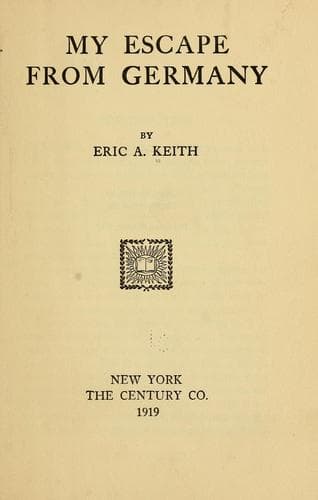
Prisoner-of-war escapes; World War, 1914-1918 -- Prisoners and prisons, German
During the first part of this last stretch of an hour and a half we
remained alone. Dusk was rapidly changing into total darkness. Soon
it became impossible to distinguish the names of the feebly lighted
stations. I checked them carefully from the open time-table beside me,
lest we should alight too soon or too late.
At 8:30 we arrived at Cloppenburg. The first and probably the most
dangerous part of our venture lay behind us.
CHAPTER XXII
ORDER OF MARCH
My two companions had entrusted themselves to my leadership for the
tramp to the frontier. My first business was to pilot them out of town
from the right side, if possible, and, what was more difficult, by the
most favorable road. I thought it, under the circumstances, about as
hard a task as could be set me, at the very beginning. If so slight
an undertaking as ours may be spoken of in military terms, I should
compare it to a rearguard action and the successful withdrawal from
touch with the enemy’s advance scouts.
It was a very dark night. Only occasional stars glimmered through
the canopy of clouds. I knew nothing of the town, except what little
information could be gleaned from a motor-map, scale 1 to 300,000. The
time-table had taught us that we were to arrive at one station, and
that a train was to start from another about half an hour later. A
number of people were likely to change from the one to the other. To
follow them, as if we were of the same mind, would give us a start
off and carry us beyond the eyes of the railway officials. After that
I should have to do the best I could, without the help of either a
compass, which I could not consult, or the stars, which were not in
evidence.
As long as we were likely to meet people the order of march was to be:
I in the van, Tynsdale and Kent in the rear, as far behind as possible
without losing touch.
Most of the people who had left the station with us kept on the same
road, thus proving our calculation correct. We walked in their rear,
I carrying the portmanteau, which rapidly grew heavy. Big trees lined
the streets throughout; their shadows made it impossible to see more
than a few steps ahead. I followed behind the other travelers more by
sound than by sight. My companions had to keep within arm’s length of
me. There seemed to be a maze of streets, and, trusting to luck, I
turned into one of them. We found ourselves alone. At another corner,
instinct bade me take a sharp turn to the right. Then the streets lost
their character as such. Houses seemed to be irregularly dotted about
on bare ground underneath towering trees. Again they drew together into
a street, or a semblance of one. Here my friends closed up, and I gave
the leaden-weighted portmanteau to Kent. A furtive peep at the compass
heartened me a little. It seemed as if open country appeared in front,
but it was difficult to tell. Near a lamp, three girls passed us, arm
in arm. Inquisitively they turned their heads.
Public-domain text, read in full here on John Shaqi.
Reviews
Reviews
No reviews yet
Be the first to share your thoughts on this work.
Elsewhere in the archive
Join the Discussion
Join the discussion
Sign in to leave a comment or review.
Sign InorCreate an account