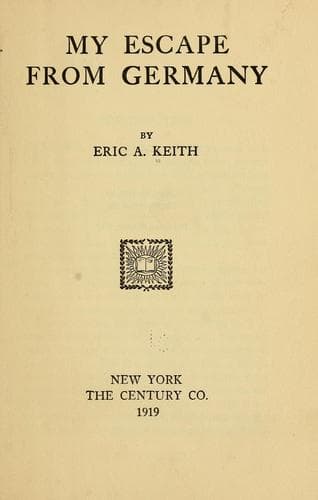
Prisoner-of-war escapes; World War, 1914-1918 -- Prisoners and prisons, German
“I’d like to know how many of these beastly poles with the direction
boards missing we’ve seen so far! Do the Boches think they can make it
more difficult for an invading army or something, by knocking their
sign-posts to pieces?”
For the next hour and a half our way lay through dense forest. The
straight, very wide clearing which served as a road was ankle-deep
in sand. As it yielded and gave way under the backward pressure of
our hurrying feet, it produced the nightmarish sensation of striving
hopelessly in a breathless flight against a retarding force. Thousands
of fireflies dotted the roadside with points of greenish light, or
drew curves of phosphorescence in the air. A heavy shower urged us to
assume the sweltering protection of our raincoats. Several times I
checked the direction of the road at its beginning, and even borrowed
Tynsdale’s compass for the purpose, as the needle of mine seemed to
move sluggishly, but I noticed nothing wrong.
* * * * *
The next village, which we entered soon after midnight, looked quite
different from what we had expected. It was of considerable size.
The streets were in darkness, although electric street lamps were
installed. But the yellow squares of numerous lighted windows told of
many inhabitants not yet in bed. Near the church we turned into a road
on our right. Among the last houses I checked the road’s direction.
“It isn’t the road we want,” was my conclusion. “Leading too directly
north. We’d better go back and look for the right one. What d’you
think?”
“D’you think it safe?”
“Well, we haven’t much time to spare. But the streets are dark enough.
We might risk it.”
Again we passed in front of the church. In what looked like the
vicarage at one side, three large windows lit the road in front. A
shadow passed over the blinds. A door banged. Hurriedly we dived into
the shadow farther on. The footfalls of a single man sounded behind us,
ominously determined it seemed. It was too dark to see more than three
or four yards, but we were sincerely glad when the sound was gradually
left behind and we found ourselves in the open country on a sort of
cart track.
“This isn’t the road, either. Too far west this time,” was my
conclusion. “The former road is the better of the two. We’ll strike
back to it across-country.”
We did so in twenty minutes’ work over fields. It soon began to tally
better with the direction on the map. Two hours through firefly
infested forest saw us enter another village, as dark and as safe as
any we had yet passed through. At its farther end we stopped.
Public-domain text, read in full here on John Shaqi.
Reviews
Reviews
No reviews yet
Be the first to share your thoughts on this work.
Elsewhere in the archive
Join the Discussion
Join the discussion
Sign in to leave a comment or review.
Sign InorCreate an account