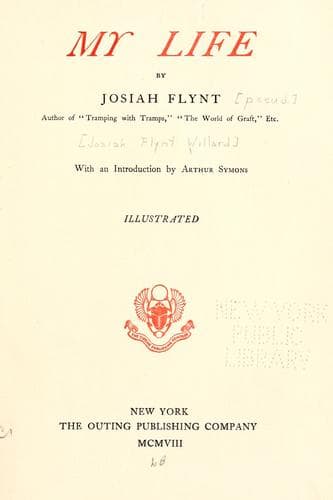
In "My Life," Josiah Flynt says, "I have spoken of Arthur Symons'
interest in my first efforts to describe tramp life. I think it was he
and the magazine editors who abetted me in my scribblings, rather than
the university and its doctrines of 'original research.'... His
(Symons') books and personal friendship, are both valuable to me, but
for very different reasons. I seldom think of Symons the man, when I
read his essays and verses, and I only infrequently think of his books,
or of him as a literary man at all, when we are together."
Josiah Flynt not only greatly admired Arthur Symons, the distinguished
Englishman, as poet, master of prose, and critic, but had an
affectionate regard for him, one expression of which was his use of the
nickname, "Symonsky." While Flynt's guest in Berlin, Symons had some
difficulty in persuading a letter-carrier that a communication from
London was for Arthur _Symons, Esq._, and not for some _Herr Symonsky_!
The Slavic twist to the name amused Flynt, who seized upon it. His shy,
affectionate nature found an outlet in renaming close friends.
After one of his visits to London, I asked Flynt if he had seen much of
Symons.
"Symonsky put me up, you know," he replied; then with a quick, side
glance and a smile, as he lighted a cigarette, "but, to be perfectly
frank, when _I_ went to bed, _he_ was getting up!"
Here we have defined in a sentence the difference between the two men.
Their natures, like their lives, were never parallel; they only just
touched one another's imaginations in passing!
Flynt was then studying London's _Under World_--the great city's
blackest corners and darkest ways; while Symons, as it chanced, was
seldom out of the lime-light circle of London concert halls, preparatory
to writing his "London Nights."
Both men were the sons of clergymen, and launched in life's calmest,
safest waters, at about the same time, though on opposite sides of the
Atlantic. It was their own volition which led them to take to life's
high seas. Symons went from his small town to London, which, in spite of
continental sojourns, has remained his permanent mooring. Flynt took to
the "open" at an early age, and tied up in whatever harbor the storm
drove him. American by blood and birth, he felt at home in Russia,
Germany, France, or the British Isles, if given the _Mask of No
Identity_.
One of the swiftest currents of London life flows down the Strand.
There, Josiah Flynt, in what disguise he chose, could do his "work,"
and, when he would, step over the sill of the old Temple and find a
welcome from his friend, who had chambers in Fountain Court, that
silent square of green, which slopes to the Thames, and is kept fresh
and cool by its jets of water and great shade trees. Symons lived in the
building to the right, after entering the Court, and up a winding flight
of old stone steps.
Public-domain text, read in full here on John Shaqi.
Reviews
Reviews
No reviews yet
Be the first to share your thoughts on this work.
Elsewhere in the archive
Join the Discussion
Join the discussion
Sign in to leave a comment or review.
Sign InorCreate an account