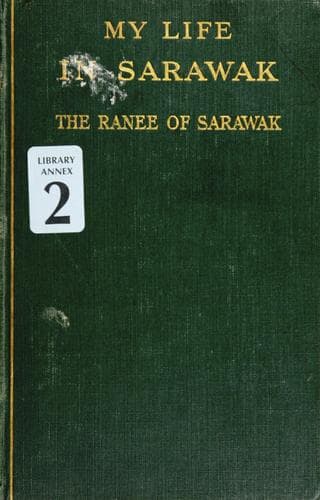
Brooke, Margaret, Lady, 1849-1936; Queens -- Malaysia -- Sarawak -- Biography; Sarawak (Malaysia) -- Description and travel
The Rajah was called away from Kuching during the epidemic, and I was
alone with the children at the Astana. One morning, a chief, whom I
knew very well, paid me a friendly call. We sat and talked on the
verandah, and I thought he had never been so talkative or seemed so
full of life as on that particular morning. About eleven o’clock we
shook hands, and he went back to his house. That same day, as I was
getting up after my afternoon nap, Talip came to my room and asked
whether Datu Mohammed’s wife could have some flowers from our garden.
“Certainly,” I said; “tell them to pick what flowers they like. But I
did not know Datu Mohammed was having a feast to-day.” “He is not,”
Talip replied; “he died of cholera at three o’clock.” This was said
with a smile, for Malays, whenever they have sorrowful or tragic news
to impart, always smile, in order, I suppose, to mask their feelings.
The death of a favourite cat would elicit sighs and groans, but in any
sorrow they hide their true feelings, even from their nearest relations.
Some of the Malays had curious methods in trying to combat the disease.
There was an old lady living in Kampong Grisek, called Daiang Kho, who
was beloved by the Malays of Kuching on account of her blameless life,
her rigorous attention to religious duties, and above all, because she
had achieved the great pilgrimage to Mecca. Daiang Kho had brought with
her from Mecca a Muhammadan rosary, and this was made great use of in
cases of illness in Kuching. The rosary was placed in a tumbler of cold
water over night, and the liquid poured into various bottles the next
morning, to be used as medicine. Daiang Kho informed me that the cures
performed by the rosary were wonderful, but, as we all know, in some
cases mind triumphs over the body, and I was not therefore surprised
at hearing that this innocuous drink had sometimes been successful in
curing sufferers when attacked by the first symptoms of disease.
CHAPTER XXI
During one of my visits to England our youngest son Harry was born.
He is called Tuan Bungsu (the youngest of a family), a title given to
the youngest son of the Rajahs of Sarawak. As time went on and our
boys were growing up, it became incumbent on me, for obvious reasons,
to spend more time away from our country. I had to make my home in
England, on account of the education of our sons, but, whenever
possible, I hurried over to pay visits to what is, after all, my own
land. I think one of the happiest periods of my life occurred just
before Bertram went to Cambridge, when he accompanied me to Sarawak. We
then stayed there some months, part of which time the Rajah was obliged
to be in England.
Public-domain text, read in full here on John Shaqi.
Reviews
Reviews
No reviews yet
Be the first to share your thoughts on this work.
Elsewhere in the archive
Join the Discussion
Join the discussion
Sign in to leave a comment or review.
Sign InorCreate an account