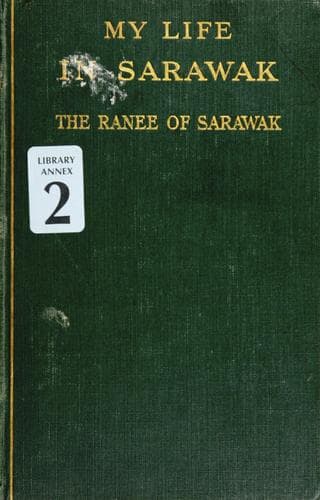
Brooke, Margaret, Lady, 1849-1936; Queens -- Malaysia -- Sarawak -- Biography; Sarawak (Malaysia) -- Description and travel
trunks of trees, falling in cascades of colour above our heads, forming
a perfect bower. We all stood still, silently looking at them. At
length Miss North remarked: “And you said yesterday there were no such
things in the country!”
Miss North remained with us about six weeks, and when I very
sorrowfully accompanied her on board the steamer on her return to
England, I felt that something new and delightful had come into my
life, for she had not only introduced me to pitcher-plants, but to
orchids, palms, ferns, and many other things of whose existence I had
never dreamed. Miss North was the one person who made me realize the
beauties of the world. She was noble, intelligent, and kind, and her
friendship and the time we spent together are amongst my happiest
memories. She used to paint all day, and, thinking this must be bad
for her, I sometimes tried to get her away early in the afternoon for
excursions, but she would never leave her work until waning daylight
made painting impossible. I remember how she painted a sunset behind
Matang, which painting she gave to me. She sat on a hill overlooking
the river until the sun went behind the mountain. The world grew dark,
and the palms in the neighbourhood looked black against the sky as she
put her last stroke into the picture. She put up her palette, folded
her easel, and was preparing to walk home with me to the Astana, when
for some moments she stood quite still, staring at the thread of red
light disappearing behind the shoulder of the mountain. “I cannot speak
or move,” she said. “I am drunk with beauty!”
But there was one thing that Miss North and I did not agree upon. She
did not approve of the view I took of our Dyak and Kayan people. She
liked to meet Malay ladies, because, as we all know, they have better
manners than most Europeans, but she could not bear the thought of
either Dyaks or Kayans. I could never eradicate from her mind the idea
that they were savages. I used to try and interest her in these people,
for I longed that she should accompany us in some of our journeys
into the interior, but this she would never do. “Don’t talk to me of
savages,” she would say; “I hate them.” “But they are not savages,” I
would reply. “They are just like we are, only circumstances have made
them different.” “They take heads: that is enough for me,” she would
add severely, and would listen to no defence for that curious custom of
theirs, for which I could find so many excuses.
CHAPTER XVIII
Public-domain text, read in full here on John Shaqi.
Reviews
Reviews
No reviews yet
Be the first to share your thoughts on this work.
Elsewhere in the archive
Join the Discussion
Join the discussion
Sign in to leave a comment or review.
Sign InorCreate an account