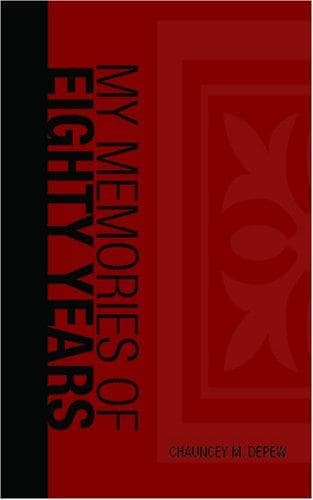
My Memories of Eighty YearsDepew, Chauncey M. (Chauncey Mitchell)
History
My Memories of Eighty Years
Depew, Chauncey M. (Chauncey Mitchell)
Biography; Depew, Chauncey M. (Chauncey Mitchell), 1834-1928; United States -- History -- 1865-1921
When the Republican convention met in 1912 I was again a delegate.
In my fifty-six years of national conventions I never had such an
intensely disagreeable experience. I felt it my duty to support
President Taft for renomination. I thought he had earned it by
his excellent administration. I had many ties with him, beginning
with our associations as graduates of Yale, and held for him a
most cordial regard. I was swayed by my old and unabated love
for Roosevelt. In that compromise and harmony were impossible.
I saw that, with the control of the organization and of the
convention on the side of Mr. Taft, and with the wild support for
Roosevelt of the delegates from the States which could be relied
upon to give Republican majorities, the nomination of either
would be sure defeat.
I was again a delegate to the Republican convention of 1916.
The party was united. Progressives and conservatives were acting
together, and the convention was in the happiest of moods. It was
generally understood that Justice Hughes would be nominated if
he could be induced to resign from the Supreme Court and accept.
The presiding officer of the convention was Senator Warren G. Harding.
He made a very acceptable keynote speech. His fine appearance,
his fairness, justice, and good temper as presiding officer
captured the convention. There was a universal sentiment that if
Hughes declined the party could do no better than to nominate
Senator Harding. It was this impression among the delegates, many
of whom were also members of the convention of 1920, which led
to the selection as the convention's candidate for president of
Warren G. Harding.
My good mother was a Presbyterian and a good Calvinist. She
believed and impressed upon me the certainty of special Providence.
It is hard for a Republican to think that the election of
Woodrow Wilson was a special Providence, but if our candidate,
Mr. Hughes, had been elected he would have had a hostile Democratic
majority in Congress.
When the United States went into the war, as it must have done,
the president would have been handicapped by this pacifist Congress.
The draft would have been refused, without which our army of
four millions could not have been raised. The autocratic measures
necessary for the conduct of the war would have been denied.
With the conflict between the executive and Congress, our position
would have been impossible and indefensible.
I had a personal experience in the convention. Chairman Harding
sent one of the secretaries to me with a message that there was
an interval of about an hour when the convention would have nothing
to do. It was during such a period the crank had his opportunity
and the situation was dangerous, and he wished me to come to
the platform and fill as much of that hour as possible. I refused
on the ground that I was wholly unprepared, and it would be madness
to attempt to speak to fourteen thousand people in the hall and
a hundred million outside.
Public-domain text, read in full here on John Shaqi.
Reviews
Reviews
No reviews yet
Be the first to share your thoughts on this work.
Elsewhere in the archive
Join the Discussion
Join the discussion
Sign in to leave a comment or review.
Sign InorCreate an account