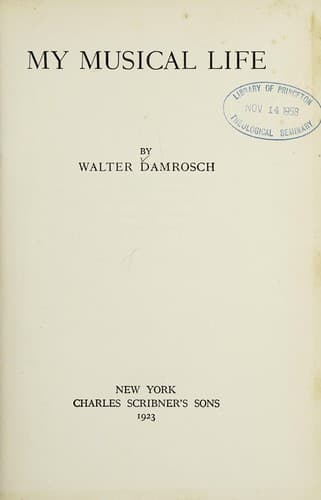
Conductors (Music) -- United States -- Biography; Damrosch, Walter, 1862-1950
My wife and I became very fond of him and, later on, when he and I
joined the Metropolitan Opera House Company, again under Maurice Grau,
we would often take our meals together on the long Western trips to and
from California.
He was exceedingly irascible if servants did not carry out his orders
properly, and he would berate them in his very resonant voice with a
distinctness of utterance worthy of the _Comédie Française_. One morning
we were seated at breakfast in the dining-car of our train when the
colored waiter brought him his coffee, which was so weak that a drop of
the so-called cream turned it a bluish gray. “Take away that coffee!”
Bispham thundered. “It is not fit to drink. It is too weak!”
“Oh, no, sah!” expostulated gently the waiter. “Dat coffee am all right.
It’s de cream what’s too powerful strong!”
At that time leather suitcases were just making their first appearance
and I had bought one and carried it about with me. Bispham noticed it
and said, in his extreme Kensington English, which he had carefully
acquired over there: “Walter, that is a very nice bag you have there. I
think I will buy four of them, each one a little smaller than the other,
so that I can put them all inside each other.”
“Why,” I said, “David, aren’t you going to pack anything else inside of
those bags?”
“Ha, ha, ha!” laughed David. “Walter, you are always having your little
joke!”
Whenever my opera company came to Boston the supers, when an extra group
or crowd of knights or peasants, etc., were necessary, were always taken
from Harvard University. This became a source of enormous revenue to the
doorkeeper at the stage entrance. Our stage-manager paid him twenty-five
cents for each super, but he not only pocketed this money himself but
charged the students anywhere from fifty cents upward, according to the
popularity of the opera, for the privilege of hearing it from the stage.
In consequence we often had the most wonderful athletic specimens that
the ardent pursuit of sport produces among college men, delighting our
eyes as the curtain rose, and the knights and nobles in the second act
of “Tannhäuser,” for instance, clad in magnificent robes, would march in
and solemnly listen to the contest of song in the castle of the
Landgrave of Thuringia.
But they were not all athletes, and I remember one real student among
them. The curtain went up on the first act of “Lohengrin” and, to my
amazement as I looked up from my conductor’s stand, I saw one of these
college boys, dressed in the armor and cloak of one of King Henry’s
knights, calmly standing at the foot of the throne, large spectacles on
his nose, busily following the action of the opera from a libretto which
he held in his hand and close to his eyes.
Public-domain text, read in full here on John Shaqi.
Reviews
Reviews
No reviews yet
Be the first to share your thoughts on this work.
Elsewhere in the archive
Join the Discussion
Join the discussion
Sign in to leave a comment or review.
Sign InorCreate an account