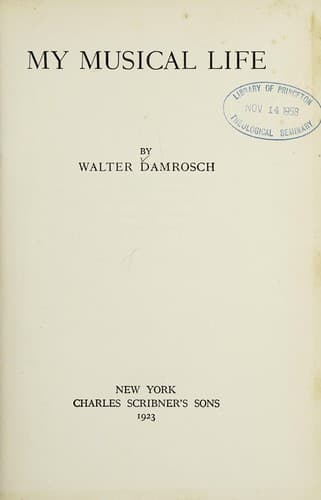
Conductors (Music) -- United States -- Biography; Damrosch, Walter, 1862-1950
But my schoolboy adoration received a severe shock when, on the last day
of our tour, a handsome and very robust Italian barytone, by the name of
Tagliapietra, came to meet her and I found that she was madly in love
with him. They were married a short time after.
She, too, seems to have been unconscious of my adoration. Thirty-two
years later, at a dinner given at the Hotel Plaza in honor of my
twenty-fifth anniversary as a conductor, she was present and in my
speech of thanks I humorously referred to her as the _grande passion_ of
my early youth. She afterward told my sister: “I never knew that Walter
had felt like that about me!”
To proceed with my confessions. The following year I met—but, alas,
this chapter is already overcrowded and I shall have to continue the (to
me) so fascinating recital of my various romances in my next book of
memoirs, which I expect to publish in about twenty years.
XIII
THE ORATORIO SOCIETY OF NEW YORK
My father had always considered that a study of the oratorios of Bach
and Handel was a highly important foundation for the young musician, and
I had spent many hours with him in studying their scores and imitating
their form in my own counterpointal work. Bach’s “St. Matthew’s Passion”
and Handel’s “Messiah,” “Samson,” and “Judas Maccabæus” I knew virtually
by heart. My father also believed the development of amateur choruses to
be a very strong factor in the musical growth of a people. Under his
inspiration the chorus of the Oratorio Society constantly grew in
numbers and technical proficiency; but it suffered from the great dearth
of men singers, especially tenors. The terribly one-sided condition of
musical development in our country, proceeding almost exclusively on
feminine lines, showed itself markedly in this branch of the art. Many
of the men singers who in one way or another had been cajoled or coerced
into joining a choral society, had often to be drilled in their parts
like children, though without a child’s quickness of perception. The
result was that the labor of training was incessant and the mistakes of
one year repeated themselves inevitably the next. In rehearsing such
oratorios as Handel’s “Messiah” or Bach’s “St. Matthew’s Passion,” for
instance, a good routined conductor could always prophesy beforehand
what mistakes the chorus was going to make.
Public-domain text, read in full here on John Shaqi.
Reviews
Reviews
No reviews yet
Be the first to share your thoughts on this work.
Elsewhere in the archive
Join the Discussion
Join the discussion
Sign in to leave a comment or review.
Sign InorCreate an account