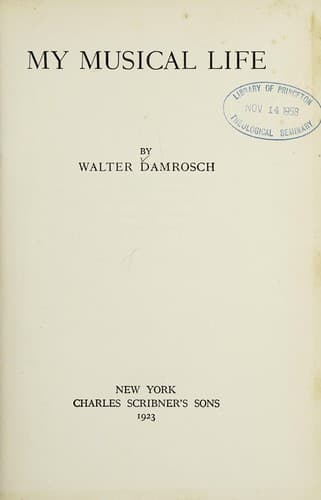
Conductors (Music) -- United States -- Biography; Damrosch, Walter, 1862-1950
His activities extended in many directions. He founded the Young
People’s Concerts at Carnegie Hall, and became supervisor of music in
the public schools of New York, completely reforming the teaching of
music. The good effects of this are felt to this day. He also founded
the People’s Choral Union, in which working men and women were taught
singing and the rudiments of music and then promoted into a chorus of
twelve hundred voices which studied and performed the old oratorios of
Handel and Haydn.
He officiated as conductor of the Oratorio Society from 1898 until 1912,
and during this period conducted first performances in New York of
Edward Elgar’s “The Dream of Gerontius” and “The Apostles,” Anton
Dvořák’s “Stabat Mater,” Gabriel Pierné’s “Children’s Crusade,” Johannes
Brahms’s “Song of Fate,” and Wolf-Ferrari’s “La Vita Nuova.”
His interest in the pedagogy of music culminated in the founding of a
music-school—the Institute of Musical Art—which was liberally endowed
by James Loeb and others, and which has developed into one of the few
great music-schools of this country and Europe. This school soon began
to assume such proportions as to demand all of his time and vitality. He
therefore retired from other public work, with the exception of the
conductorship of the Society of Musical Art, a unique chorus of
sixty-five professional singers, giving only two concerts during the
season, representing the highest that can be attained in choral singing.
For its programmes he drew upon the rich and partly unknown treasures of
the _a capella_ choruses of such masters as Palestrina, Orlando di
Lasso, Cornelius, and Brahms; and as this chorus was composed of the
very elect of New York’s church and concert singers he obtained results
ravishing in their beauty.
When we were boys together we quarrelled dreadfully and outrageously.
Frank would try to assert his two years’ seniority over me and I would
resent this with both hands and feet. I remember my mother resolutely
separating us and giving me a little room to myself, as that seemed the
only way to achieve peace between us. But I am happy to say that since
1885, when Frank returned to New York, we have lived and worked together
in absolute harmony and mutual helpfulness. In fact, the unity between
us has been so complete that we are now inclined by contrast to consider
each other as having been exceptionally devilish and nasty during those
early boyhood years. I know, of course, that the blame was entirely his,
as he was so overbearing and presuming because of the accident of his
earlier birth, while he is equally convinced that I was altogether too
cheeky for my age and it was absolutely necessary for my own good and
future welfare to put me where I belonged.
Public-domain text, read in full here on John Shaqi.
Reviews
Reviews
No reviews yet
Be the first to share your thoughts on this work.
Elsewhere in the archive
Join the Discussion
Join the discussion
Sign in to leave a comment or review.
Sign InorCreate an account