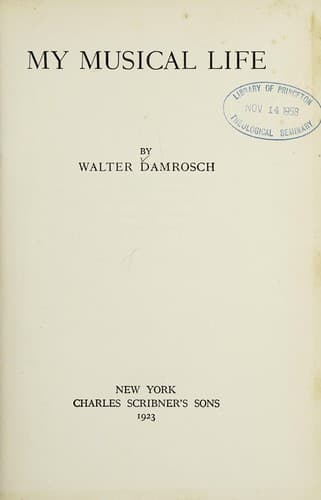
Conductors (Music) -- United States -- Biography; Damrosch, Walter, 1862-1950
After my father’s death I was elected, at the age of twenty-three,
conductor of the New York Symphony Society. We used to give six concerts
and six public rehearsals during the winter, and for the seven years
following my election this orchestra was also employed for the German
opera at the Metropolitan. But when German opera was supplanted by
Italian under Abbey, Schoeffel, and Grau, I was hard put to it to find
sufficient work for my men to keep them together. The little subsidy
which was at that time contributed by the directors of the Symphony
Society was only large enough to give the six regular concerts of the
winter season. I had learned the difficult art of accompanying soloists
sympathetically with the orchestra, and the foreign artists who came to
America, such as Sarasate, Ysaye, d’Albert, Joseffy, Paderewski,
Kubelik, and many others, always chose my orchestra to accompany them.
But these concerts were comparatively few, and I had to look for other
ways of giving my men enough work to make it worth their while to stay
with me instead of accepting travelling engagements with little opera
companies, etc. Gradually I developed Sunday-afternoon symphony
concerts, a complete innovation, as up to that time the only music given
on Sundays was in the evening and of the more popular and trivial
character. I argued that Sunday was the one day in the week when men
were not immersed in business cares, and that on that day they and their
families would be more susceptible to the appreciation of a higher and
more serious class of music. I therefore boldly inaugurated a series of
symphonic concerts for every Sunday afternoon during the winter; and my
faith was justified, as not only were these concerts attended by huge
audiences, but the percentage of men was greater than had ever been seen
at symphony concerts before. For several years I enjoyed a monopoly of
my idea, but then other orchestras and soloists perceived its value, and
to-day I have to share Sunday afternoons with two or three other
organizations who also give high-class concerts, all of which are
generally well attended.
I also gradually developed long spring tours with fifty men, which in
those days was considered a travelling orchestra of good size. On these
tours I penetrated the South, the Middle West, and, later on, the Far
West of California and Oregon.
Many of the communities that we visited had never heard a symphony
orchestra before, and for them we did real pioneer work, as I maintained
a high standard of music on my programmes. The classics were, of course,
the foundation; but Wagner very soon became a great drawing power, and
Wagner programmes were often the most asked for.
Public-domain text, read in full here on John Shaqi.
Reviews
Reviews
No reviews yet
Be the first to share your thoughts on this work.
Elsewhere in the archive
Join the Discussion
Join the discussion
Sign in to leave a comment or review.
Sign InorCreate an account