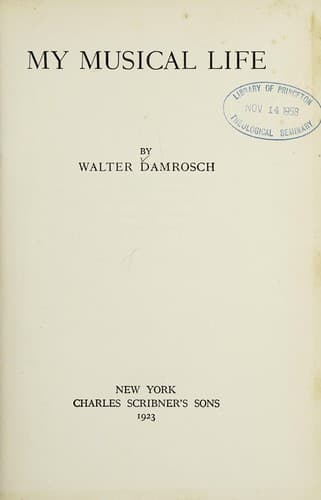
Conductors (Music) -- United States -- Biography; Damrosch, Walter, 1862-1950
In contrast to this experience I should like to relate what happened
another time when we were giving a symphony concert, perhaps the first
ever heard there, at Fargo, North Dakota. Efrem Zimbalist, delightful
man and artist, was our soloist on this tour, and after the concert,
when we met for supper, he related with shouts of laughter that while I
was playing the “Lenore” Symphony, by Raff, he was sitting behind the
scenes of the “opera-house”—every Western city has a “grand
opera-house”—listening to the music, when a cowboy, young, handsome, in
flannel shirt, high boots, slouch hat, etc., came on the stage and sat
down amicably next to him. The cowboy was perhaps a little “mellow,” as
this was before the days of national prohibition, but he evidently had a
musical ear, although he had never before in his life heard a symphony
orchestra. Every time that the music developed into a kind of joyous
climax, he would grab Zimbalist’s knee in convulsive delight and shout:
“God damn it, but I like that music!” Then he would sit in rapt silence
until the next outburst, when he would again grab Zimbalist and shout:
“They can go to hell, but they know how to play!” We all envied this
man, because, no matter how much we may appreciate music, we have heard
so much that we can never again experience the thrill of hearing a
symphony orchestra for the first time in our lives.
The story, of course, went the rounds of the orchestra, and for weeks
afterward, if we were seated in the dining-car of our train, the voice
of one of the musicians might be heard above the roar of the cars and
the din of the clattering knives and forks shouting in joyous accents:
“God damn it, but I like this omelet!”
Speaking of dining-cars, on one of our Western tours during the first
years of the war we had heard much about the sad conditions of the
Belgians, whose territory had been so ruthlessly overrun by the German
armies. Our entire orchestra had just responded unanimously and
generously in contributing toward the Belgian Relief Fund, and in the
dining-car at the table opposite mine were seated our second flute
player, a Belgian, together with his son, who was one of our talented
violoncellists. Their plates were heaped with turkey, cranberry sauce,
and potatoes, and there was an apple-pie in the offing. I said: “I
thought the Belgians were starving!” “Oh,” said Barrère, the ever-ready
and ever-witty, “ils mangent pour les autres.”
Public-domain text, read in full here on John Shaqi.
Reviews
Reviews
No reviews yet
Be the first to share your thoughts on this work.
Elsewhere in the archive
Join the Discussion
Join the discussion
Sign in to leave a comment or review.
Sign InorCreate an account