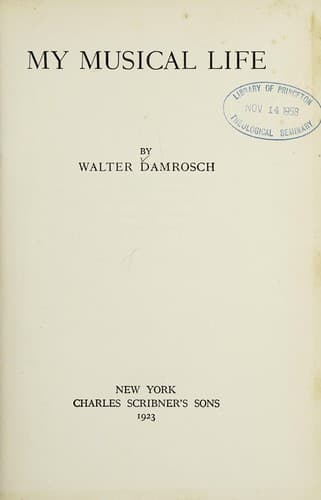
Conductors (Music) -- United States -- Biography; Damrosch, Walter, 1862-1950
Such festivals devoted exclusively to the work of one composer are a
great lesson to the serious music lover, and I think that as Beethoven
represents almost the alpha and certainly the omega of symphonic music,
there should be repetitions of Beethoven cycles every few years. I have
never been able to understand why it should not be similarly possible to
give Shakespearian cycles in spring, in which all of our best actors
could combine to make up ideal casts. We should certainly make American
children as familiar with Shakespeare’s great tragedies as, for
instance, the children of Germany, to whom Shakespeare is much more of a
household word than he is to those of this country or England. If music
can find Flaglers and Higginsons to endow it as an educational
necessity, why cannot similar men be found to do the same for the drama
and thus help to lift it as an educational factor from its painfully
weak position to which the necessities of making it a paying institution
have driven it.
During all these years my relations with Mr. and Mrs. Flagler became
more and more intimate. I had never met such people in my entire life.
Their devotion to and interest in the orchestra increased constantly,
and Mr. Flagler’s contributions to the fund became greater and greater
as the needs of the orchestra increased. But his help was offered with a
shyness, as if it had been the orchestra that conferred the benefit upon
him. He also took over a work which I had always detested more than
anything else, and that is the collection of funds. As the expenses of
the orchestra increased with the years, it became necessary to collect
money from outside sources beyond the large sums already contributed by
the directors of the society. With constant good humor, patience, and
infinite tact Mr. Flagler, whose own donations to the fund were greater
in proportion to his income than those of many others, would write
letters or call personally on well-to-do musical patrons to collect
perhaps a few hundred dollars toward the fund, and he would be
inordinately proud of his success as a financier and collector.
Finally even his infinite patience wore out under this yearly strain and
this manifested itself in a very remarkable way.
In the spring of 1914 he quietly informed me that he had decided to
assume the entire financial responsibility of the orchestra himself and
to contribute all necessary funds for its proper maintenance. This
amount was double what would have been considered necessary ten years
before, but salaries of orchestral players and other expenses in
connection with the giving of concerts had increased enormously and it
was Mr. Flagler’s desire that, while there should be no waste, the
affairs of the orchestra should be managed in such liberal fashion that
the artistic needs could first be considered in shaping its policy.
Public-domain text, read in full here on John Shaqi.
Reviews
Reviews
No reviews yet
Be the first to share your thoughts on this work.
Elsewhere in the archive
Join the Discussion
Join the discussion
Sign in to leave a comment or review.
Sign InorCreate an account