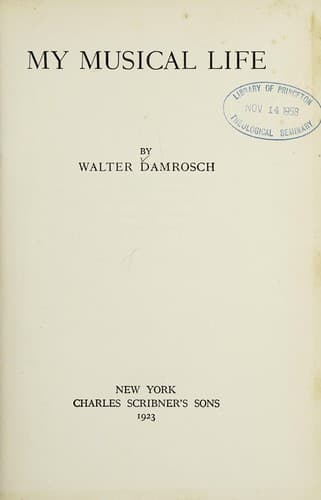
Conductors (Music) -- United States -- Biography; Damrosch, Walter, 1862-1950
The assurance of a safe-conduct from the Ministère des Etrangères was a
rather important item as I had been born in Germany, even though only
the first nine years of my life had been spent there. My father
emigrated to America in 1871, and as I had received my education here,
had lived in America ever since, and had married an American, I had
never felt myself anything but an American and of the most enthusiastic
variety. When the Germans invaded Belgium, when they sank the
_Lusitania_, and when they seemed to have broken all laws of
international relations, I expressed myself, both personally and in
newspaper interviews, so strongly that long before we entered the war
several Berlin newspapers violently took me to task and honored me by
calling me a renegade and a traitor to the country of my birth.
There was an understanding between our country and France that no
American civilian of German birth should be permitted to enter France
except by special permission of either M. Clemenceau or M. Pichon, then
Minister of Foreign Affairs. The French high commissioner cabled to the
latter and in most cordial terms recommended that I be permitted to
enter France, both because of my office as president of the Society of
American Friends of Musicians in France, and because of a life-long
admiration for French music, which I had demonstrated for thirty-three
years by producing in our country nearly every important symphonic work
that French composers had written before and within that time.
M. Pichon promptly cabled the necessary visé and with all proper
credentials I set sail on June 15, 1918, on the French steamship _La
Lorraine_.
The ship’s passengers were almost entirely soldiers and war workers.
There were two hundred and fifty Belgian soldiers with their officers
returning to France after three years spent in Russia, and who, when the
revolution broke out, had after incredible hardships reached
Vladivostok, sailing from there to California. There were Polish
soldiers on their way to join the Foreign Legion of the French army and
there were dozens of Red Cross, Y. M. C. A., K. of C., and S. A.
workers. There were not more than a dozen civilians, among them my
friend, Melville Stone, director of the Associated Press, and M. Sulzer,
the Swiss minister then accredited to our country. It was strange to be
on a transatlantic steamer without any idle rich, tourists, or
commercial travellers; and the large guns mounted fore and aft with a
gun crew watching, ready day and night, gave one a grim foretaste of the
war raging on the other side.
Public-domain text, read in full here on John Shaqi.
Reviews
Reviews
No reviews yet
Be the first to share your thoughts on this work.
Elsewhere in the archive
Join the Discussion
Join the discussion
Sign in to leave a comment or review.
Sign InorCreate an account