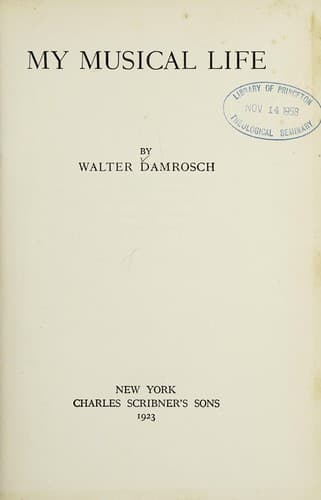
Conductors (Music) -- United States -- Biography; Damrosch, Walter, 1862-1950
It would take a man of much greater eloquence than I can claim, to give
an adequate picture of Paris at that time. It seemed to me more
beautiful and more noble than I had ever seen it during my many visits
in times of peace. The streets were almost empty, there were no
tourists, no pleasure-seekers, no idlers, and therefore that part of
Parisian life which usually stands out so prominently and which, alas,
is generally the only part that the average visitor sees, was entirely
absent. One saw only the French people going about their daily tasks and
the soldiers of France and her allies. The Champs-Élysées, the
Tuileries, and, above all, the Jardin de Luxembourg seemed more charming
than ever, but the tragic note was that the lovely children who in
former times crowded these gardens were all gone. Constant air raids and
the frequent bombardments by the “Big Bertha” had driven them away. It
was said that a million and a half people had left Paris, and that,
owing to the nearness of the German armies, the entire evacuation of the
civilian population was imminent. Rumors had it, furthermore, that all
the banks had sent their securities to Orleans and that the embassies
and various relief organizations were ready to leave Paris at a few
hours’ notice. There was not the least sign of panic, but an
indescribable sadness brooded over the city.
During the long twilight, which is the most beautiful time to see Paris,
when the sky and the clouds seem to hover most intimately and
caressingly over its wonderful vistas, I used to take long walks along
the banks of the Seine. Even the complete darkness at night, the absence
of all electric lights or signs, with only an occasional half-hidden
blue lamp here and there, made the city more picturesque and wonderful.
It was almost as if the centuries of civilization and modern inventions
had been swept away and we were back again in the time of the _Grand
Monarque_, when Paris was only dimly lighted by faintly flickering oil
lamps.
Of course, I soon made the acquaintance of the nocturnal air raids, and
when the sirens placed at various high buildings of the city sounded
their horrible warning that the German Gothas were approaching, every
inhabitant was supposed to seek shelter in the cellars. I did this
dutifully for two or three nights, but as it meant leaving one’s bed at
about 11.30 or 12 and returning at about 1.30 or 2 A. M., I gradually
realized that my own pet cowardice was more the fear of not getting
enough sleep, as I was completely knocked out during the daytime by the
lack of it. After weighing the alternatives carefully I decided to take
the small risk of remaining in my bed and getting a good night’s rest in
consequence; and having solved this question to my complete
satisfaction, I used to wake up on hearing the warning of the sirens,
stretch myself comfortably, and immediately go to sleep again.
Public-domain text, read in full here on John Shaqi.
Reviews
Reviews
No reviews yet
Be the first to share your thoughts on this work.
Elsewhere in the archive
Join the Discussion
Join the discussion
Sign in to leave a comment or review.
Sign InorCreate an account