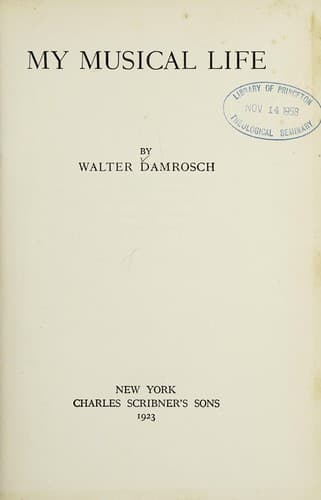
Conductors (Music) -- United States -- Biography; Damrosch, Walter, 1862-1950
I was in despair, and finally made an appeal to the orchestra in very
voluble but ungrammatical French, the gist of which was that America had
gladly sent one million soldiers to France and was getting ready to send
two millions more; all I asked in return was an orchestra of eighty men!
Could they not help me to supplement their thin ranks with a sufficient
number of trained musicians to complete the orchestra? My little speech
was received with an agitated enthusiasm. They immediately began to
gather in excited groups and swore to me that the orchestra could and
would be obtained. One assured me of a fine oboe, another of a
trumpeter, another of a first violin, and so on. M. Cortot also got
busy. He sent for Captain Ballay, the conductor of the _Garde
Républicaine_, and represented to him in what seemed to me an eloquent
oration worthy of the _Chambre des Députés_, that after Seicheprey and
Château-Thierry France could not and would not refuse an American
anything he asked for. Captain Ballay enthusiastically agreed, and
promised to send the seven members of his band whom I needed for my
concert—in the swiftest taxi-cabs he could procure—from the Trocadéro,
where the governmental celebration was to begin at three o’clock,
immediately after they had played his opening overture, to the _Salle du
Conservatoire_ at which my concert was scheduled for four. He thought
that the President of the republic was not musical enough to notice the
absence of these seven men, and that he would manage to get along
without them for the rest of his programme.
At the same time, noted French soloists who ordinarily did not play in
orchestras, offered their services—Captain Pollain, famous
violoncellist from Nancy and M. Hewitt (whose great-grandfather had been
an American but whose family had lived in France for three generations),
solo violinist of the Instruments Anciens. And at the second rehearsal,
whom should I see, but dear old Longy, for thirty years celebrated oboe
player of the Boston Symphony, who said to me most touchingly: “I see
you have no second oboe. I have no instrument in France as I left mine
in Boston, but I will borrow one and play for you if you need me.”
At my second rehearsal an excellent orchestra of seventy-seven men
assembled, and at the third the orchestra was complete, including many
French soldiers in uniform, four or five distinguished virtuosi who
played in orchestra only for this occasion, and even one of my own first
violinists from the New York Symphony Orchestra, Reber Johnson, who,
having been rejected for the army as physically not fit, had immediately
volunteered in the American Red Cross, and turned up at the rehearsal in
his uniform in the most natural way, as if this had been one of the
regular daily rehearsals of the New York Symphony.
Public-domain text, read in full here on John Shaqi.
Reviews
Reviews
No reviews yet
Be the first to share your thoughts on this work.
Elsewhere in the archive
Join the Discussion
Join the discussion
Sign in to leave a comment or review.
Sign InorCreate an account