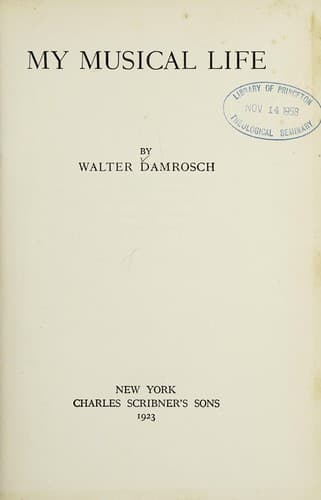
Conductors (Music) -- United States -- Biography; Damrosch, Walter, 1862-1950
We entered the house and shortly after sat down to dinner. The party
consisted of the commander-in-chief, General Bundy, and a most
delightful staff of eight officers—I being the only civilian. As such I
expected and half hoped that the talk would be all about the wonderful
success of the first day’s push by Foch, of which I had already heard
enthusiastic rumors in the town, or of great military secrets, affairs
of strategy, monster guns, thousands of airplanes, and new, mysterious
machines of destruction. But, to my surprise, the conversation during
almost the entire dinner was of music, of its influence in raising the
spirits of the soldier, in giving him the right kind of recreation and
the necessary relief from the monotony of camp work or the horrors of
battle. General Pershing told me that after hearing some of the crack
military bands of France and England he had been so overwhelmed by the
consciousness of our inferiority that he was eager to know if something
could not be done to improve the general standard of our army bands,
and, more particularly, whether it might not be possible at least to
take out the best players from among the bands then in France and to
form a headquarters band of superior excellence, led by the best
bandmaster among them, and in this way form a model which the others
could endeavor to copy. This suggestion seemed to me excellent, and I
asked how many bandmasters there were at present in France, as I would
like to examine them as to their fitness. General Pershing said, with a
smile, that there were over two hundred, but this did not phase me and I
agreed to examine them all, provided that proper arrangements could be
made for a fitting test of their qualifications. Various plans for such
an examination were discussed and General Pershing finally decided to
send them all to Paris in batches of fifty every week, together with a
military band which should be stationed there for the following four or
five weeks, thus giving me abundant opportunity to test their efficiency
in conducting as well as in harmony and orchestration. It seemed to me
at the time remarkable that, in the midst of war and with all its many
immediate necessities weighing upon him, General Pershing should have
had the acumen to perceive the value of music in war time and to
interest himself in its improvement.
Public-domain text, read in full here on John Shaqi.
Reviews
Reviews
No reviews yet
Be the first to share your thoughts on this work.
Elsewhere in the archive
Join the Discussion
Join the discussion
Sign in to leave a comment or review.
Sign InorCreate an account