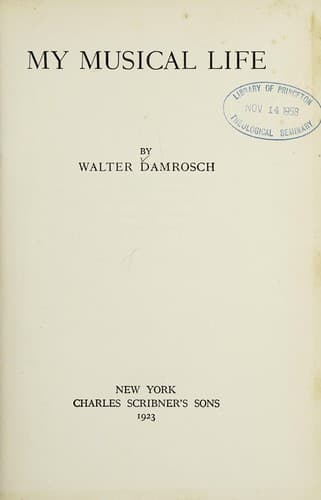
Conductors (Music) -- United States -- Biography; Damrosch, Walter, 1862-1950
The vast difference in attitude between the French and certain of my
compatriots regarding the proper stand to be taken in time of war toward
the art of an enemy nation was very striking. I had myself decided that
the New York Symphony Orchestra should not play the works of living
German composers, and that the German language should not be sung at our
concerts during the war. There seemed to me good and valid reasons for
such a course. But Beethoven, Mozart, and Wagner I considered as
classics, belonging to us just as much as to Germany, and their divine
message had naught to do with the political and military leaders of
Germany who had plunged the world into this horrible bath of blood.
There was, however, in New York a small but noisy group led by a few
women who sought to demonstrate their “patriotism” by hysterical
outbursts and newspaper protests against the performance of all music
composed by Germans, no matter how many years ago. Some of these women,
through the curious psychosis of war, really thought that they were
serving their country by their protests. In the winter of 1918 the
orchestra of the Paris Conservatoire made a tour through America under
their conductor, André Messager. When I called on him the day after his
arrival he showed me a letter he had just received from one of these
women protesting against his performing a Beethoven Symphony during his
stay in America. He was white with anger, and when I asked him how he
would answer it, he said: “I will answer it as a French artist should.”
I said: “The best way to answer would be to put Beethoven’s ‘Eroica’
Symphony on your first programme.” “I will,” he said; and he did.
The opposition to Wagner was based on very amusing premises. Because
some of his heroes were wont to appear on the stage in very blond wigs
and beards, these lady sleuth-hounds seemed to perceive some evil and
subtle connection between _Siegfried_ in the “Nibelungen Trilogy” and
Nietzsche’s “blond beast,” which, according to his prophecy, was
eventually to control the earth. Their studies of Wagner were too
shallow to enable them to realize that the whole philosophy of life as
expressed by Wagner in the “Nibelungen Trilogy” was in direct contrast
to the desire of the modern militaristic German to rule and control the
world by force. Wagner depicts a prehistoric world in which the gods of
greed, lust, and power rule, carrying, however, the seed of their own
destruction within them because of the materialistic quality of their
desires. As their power wanes and the old gods perish, a new religion is
born, the religion of self-sacrifice through love, as symbolized by
_Brunhilde_ in her self-immolation on the funeral pyre of _Siegfried_.
But all this is already ancient history, and I for one confidently
believe that the racial spirit which created the Germany of Bach,
Beethoven, Goethe, Kant, and Wagner will soon return again to brighten
and ennoble the world.
Public-domain text, read in full here on John Shaqi.
Reviews
Reviews
No reviews yet
Be the first to share your thoughts on this work.
Elsewhere in the archive
Join the Discussion
Join the discussion
Sign in to leave a comment or review.
Sign InorCreate an account